
💎 Crystal
business
How Much Bookkeeping Costs a Small Business in 2026
A clear breakdown of what you'll pay for bookkeeping by transaction volume, plus the difference between outsourced services and an in-house employee.
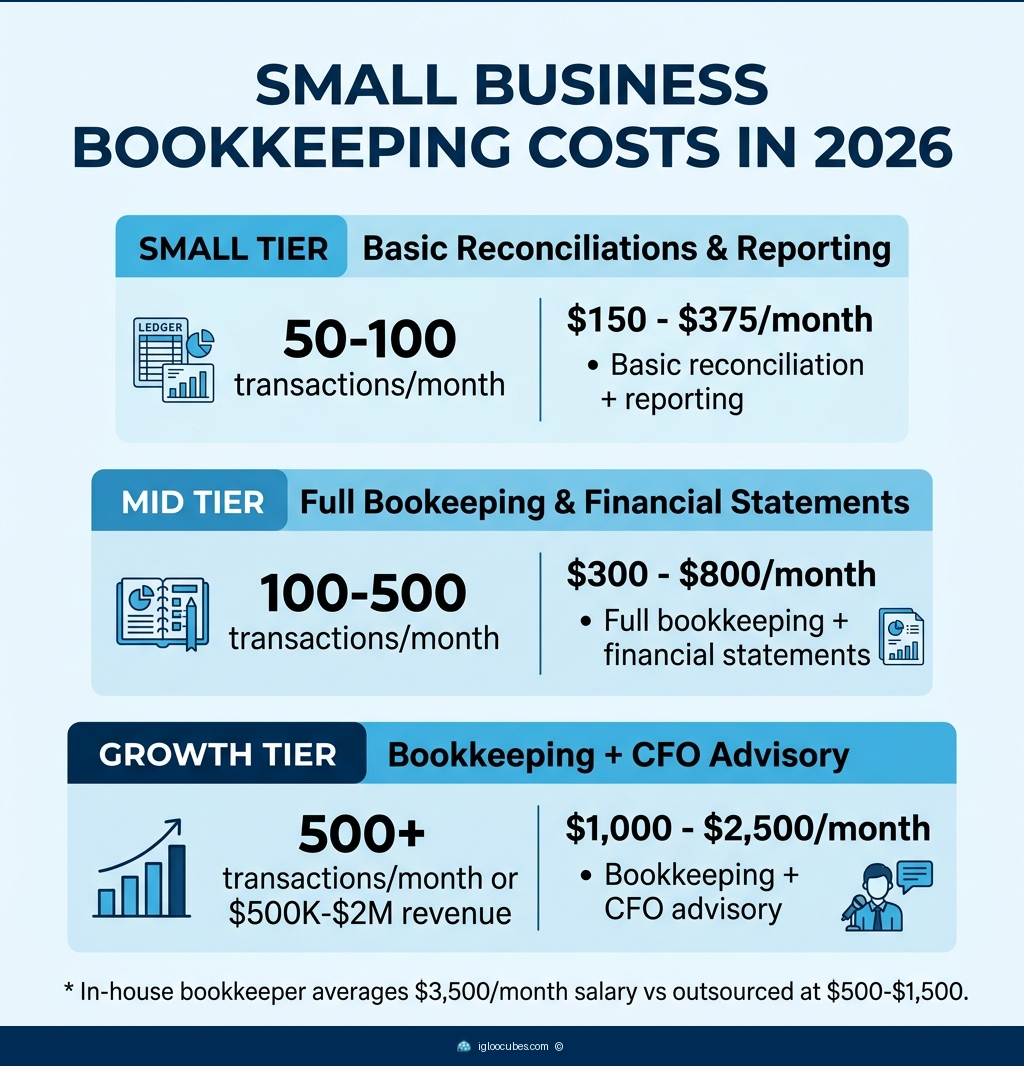
- Outsourced bookkeeping for a typical small business costs $300-$800 per month. Basic plans with simple tracking start around $150-$375; full-service plans run $1,000-$2,500.
- An in-house bookkeeper costs roughly $3,500/month in salary alone — before payroll taxes, benefits, and software costs. Outsourcing is almost always cheaper until you have enough work for a full-time role.
- Your transaction volume is the #1 pricing driver. A solo consultant with 50 transactions per month pays far less than a retail shop running 500+ transactions.
- Hourly bookkeeping rates run $30-$90 per hour. Monthly retainers are more common and predictable, typically $300-$1,500 for standard engagements.
- Growing businesses with $500K-$2M in revenue typically pay $1,000-$2,500 per month for bookkeeping that includes monthly financial statements, reconciliation, and light advisory.
Bookkeeping costs vary by how many transactions you run, not by how much revenue you bring in. A high-revenue business with few monthly transactions pays the same as a small one with the same volume.
Outsourced bookkeeping uses a monthly retainer model. For 50-100 transactions per month, expect to pay $150-$375 for basic bank reconciliation and reporting. For 100-500 transactions, the rate jumps to $300-$800 and includes full bookkeeping with financial statements. Businesses with over 500 monthly transactions or $500K-$2M in revenue typically pay $1,000-$2,500 for services that include light CFO advisory.
Hiring in-house is dramatically more expensive. A full-time bookkeeper costs roughly $3,500 per month in salary, plus payroll taxes, benefits, and QuickBooks or Xero licenses. You only break even on in-house vs. outsourced when the workload justifies a full 40-hour week of bookkeeping.
Hourly vs. retainer: A few firms still bill hourly at $30-$90 per hour, but most have moved to fixed monthly retainers. Retainers are better for both sides — predictable cost for you, predictable revenue for the bookkeeper.
What you actually get: At the $300-$500 level, you get transaction entry, bank and credit card reconciliation, and basic monthly reports. At $1,000+, you add financial statements, budget comparisons, and quarterly planning conversations.