
💎 Crystal
business
What Small Businesses Actually Pay in Credit Card Processing Fees (2026)
A side-by-side comparison of the major payment processors and their rates, plus the three fee components that eat into every transaction.
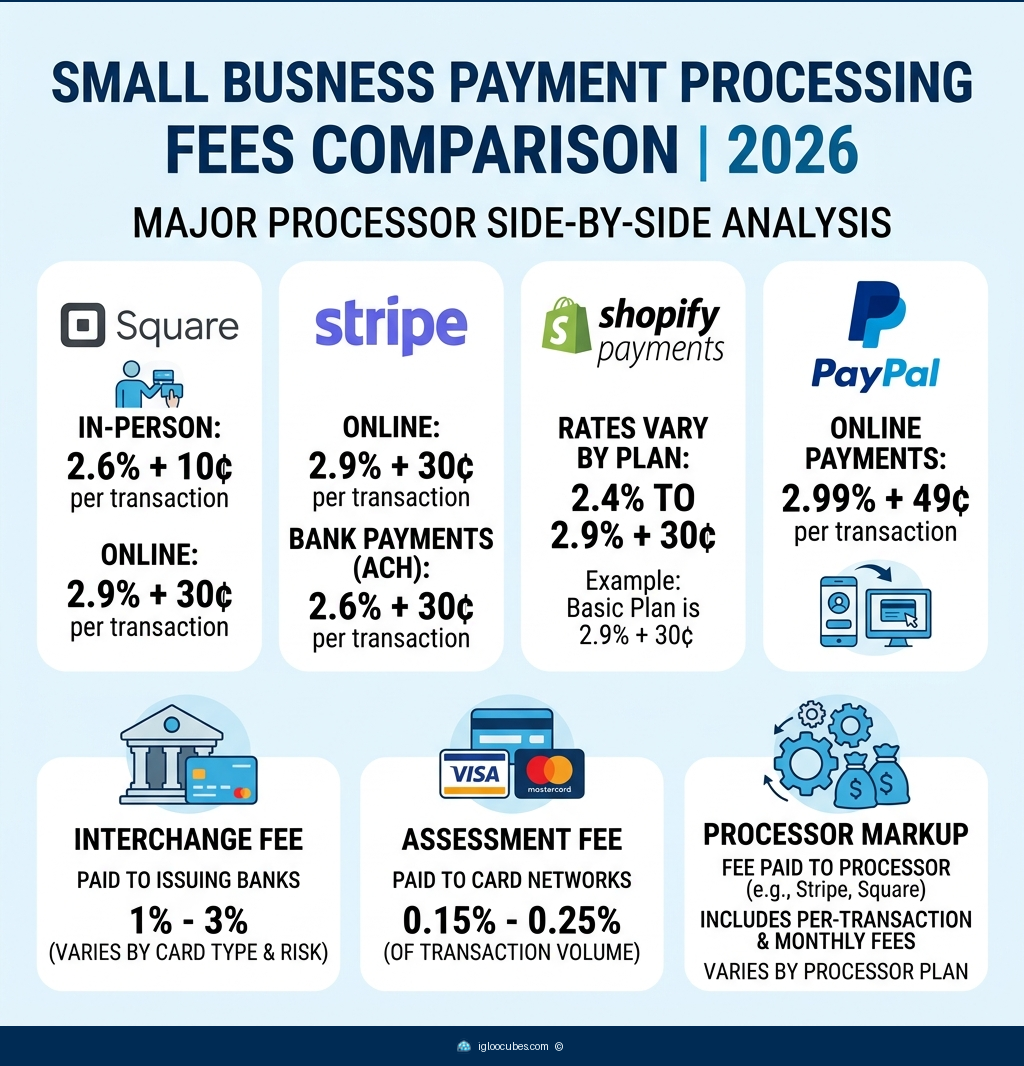
- Credit card processing fees typically cost 1.5% to 3.5% per transaction — on a $100 sale, you lose $1.50 to $3.50 before you see the money.
- Flat-rate processors like Square and Stripe charge 2.6-2.9% + $0.10-0.30 per transaction with no monthly fees or contracts. Best for small businesses doing under $10,000/month in card sales.
- Traditional merchant accounts offer lower rates (1.5-2%) but add monthly fees, contracts, and early termination penalties. Only worth it above $10,000/month in volume.
- The three fee components you're paying: interchange (1-3% to the card-issuing bank), assessment (0.15-0.25% to Visa/Mastercard), and processor markup (the processor's profit on top).
- Shopify Payments charges 2.4-2.9% + 30¢ depending on your plan. Not using Shopify Payments adds a 0.6-2% surcharge on top of the processor fee.
Every time a customer swipes, taps, or types in a card number, you lose a percentage to processing fees. The rates differ a lot depending on which processor you pick and how the customer pays.
Flat-rate processors (Square, Stripe, PayPal) are the simplest option. You pay one percentage + a flat fee per transaction, no matter what card is used. In-person rates run 2.6% + 10¢; online rates run 2.9% + 30¢. No monthly minimums, no annual contracts, no hidden fees. Best for most small businesses just getting started.
Traditional merchant accounts (Chase, Wells Fargo, Fiserv) use tiered or interchange-plus pricing. The rates look lower on paper (1.5-2%) but you pay monthly statement fees, PCI compliance fees, and early termination penalties if you leave before the contract ends. Worth negotiating once you’re doing over $10,000 a month in card sales.
Shopify and ecommerce platforms bundle processing into their subscription. Shopify Payments charges 2.9% + 30¢ on the Basic plan, 2.5% + 30¢ on the Advanced plan. If you use a third-party processor instead of Shopify Payments, you pay an extra 0.6-2% surcharge on top.
The simplest way to start: use Square for in-person payments and Stripe for online payments. No contracts, no hidden fees, and you can switch later once you have enough volume to negotiate.