
💎 Crystal
business
How Much Should a Small Business Spend on Marketing in 2026?
What the research says about marketing budgets by revenue, growth stage, and industry — plus the percentage rule that actually works.
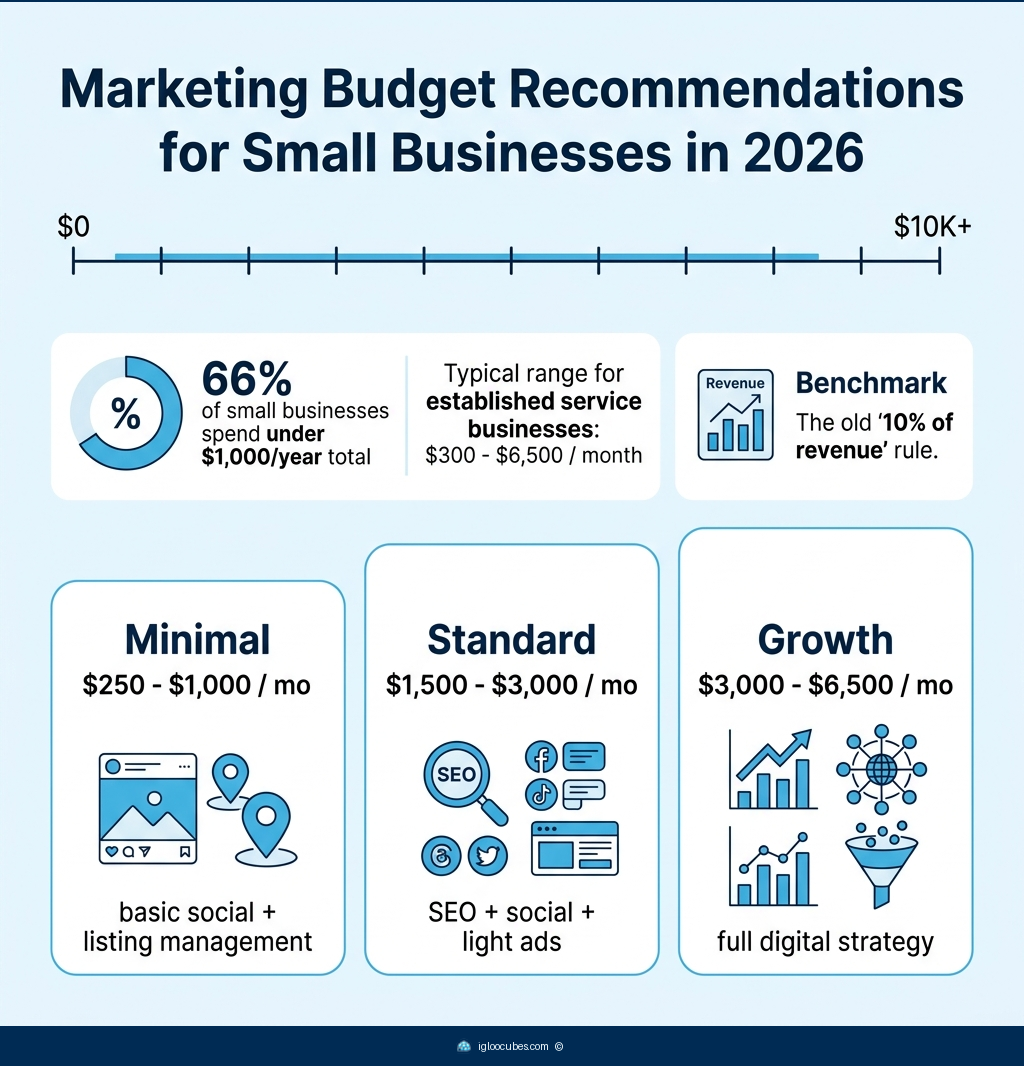
- The standard rule of thumb: budget 7-12% of gross revenue for marketing. On $100K annual revenue, that's $7,000-$12,000 per year or roughly $580-$1,000 per month.
- New businesses in their first 1-2 years should budget 12-20% of projected revenue — you're building awareness from zero and need to spend more per dollar earned.
- Most small businesses (66%) spend under $1,000 per year total on marketing, which is well below the recommended minimum. Established service businesses land around $300-$6,500 per month.
- Industry matters: restaurants, home services, and local retail need higher budgets because local search competition is intense. Professional services can sometimes spend less if referrals drive their business.
- Track every dollar — the right number isn't what you spend but what works. A $500 Google Ads campaign that brings in $2,000 in business is a 4x return worth scaling.
The most common question from new business owners is “how much do I need to spend to get customers?” The short answer is 7-12% of gross revenue, but the real number depends on your stage, margins, and industry.
The 7-12% rule works for established businesses. A bakery doing $100K in annual revenue should budget $7K-$12K per year. A plumber doing $300K should plan on $21K-$36K. This covers everything — ads, social media, website costs, signage, events, and your time.
New businesses need 12-20%. When you’re starting from zero awareness, you have to spend more per dollar of revenue just to get in the game. Once repeat customers and referrals kick in, that percentage comes down.
Industry swings the range. Restaurants, home services, and local retail compete for expensive local search terms and can easily hit the high end of the range. Professional services (accountants, consultants, lawyers) can often spend less if referrals drive most of their business.
What matters more than the number is tracking. The rule is a starting point, not a destination. Spend 10% of revenue, track what produces results, and shift money toward what works. A $500 Google Ads spend that brings in $2,000 of business is a 4x return worth scaling. A $1,000 directory listing that drives zero calls should be cut.