
💎 Crystal
tech
USB-C vs Lightning vs USB-A
It's not about the shape — it's about the performance gap. USB-C is up to 80x faster and delivers 53x more power than Lightning and USB-A.
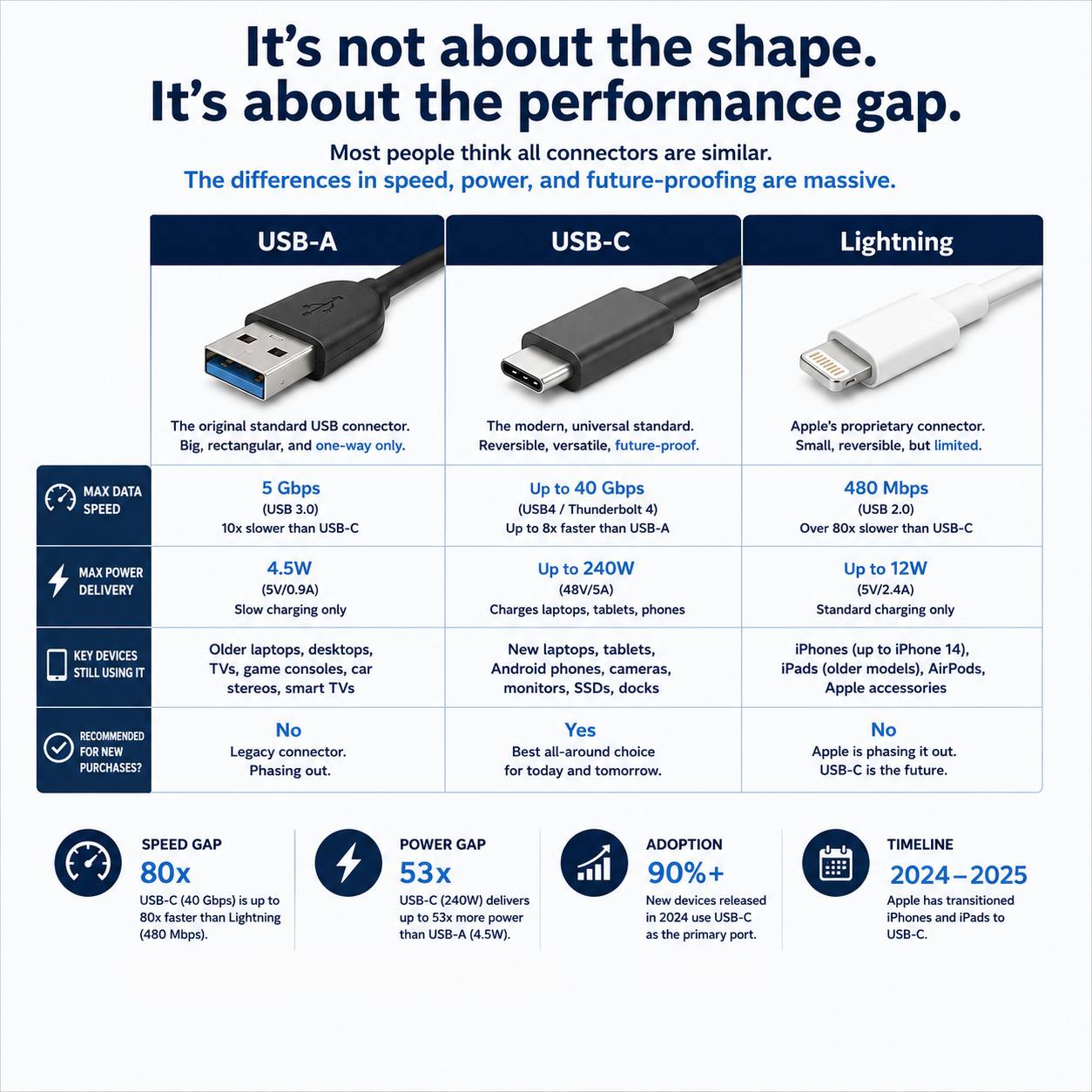
- USB-C is up to 80x faster than Lightning (40 Gbps vs 480 Mbps) and delivers up to 53x more power than USB-A (240W vs 4.5W). The performance gap is enormous.
- USB-A is a legacy connector — good for older peripherals and flash drives, but don't buy new cables or devices that rely on USB-A as the primary port.
- Lightning is Apple's proprietary connector, being phased out. iPhones (up to iPhone 14), older iPads, and some AirPods still use it — but everything new is USB-C.
- USB-C is the universal standard for new purchases: it charges laptops, tablets, phones, and accessories, transfers data at up to 40 Gbps, and 90%+ of new devices released in 2024 use it as the primary port.
Three connector standards are on most people’s desks right now: USB-A (the rectangular one), USB-C (the small oval one), and Lightning (Apple’s proprietary connector). Most people treat them as interchangeable — grab whatever cable is closest. They are not interchangeable.
USB-C runs circles around both older standards. It transfers data up to 40 Gbps (80x faster than Lightning’s 480 Mbps) and delivers up to 240W of power (53x more than USB-A’s 4.5W). That power is enough to charge a laptop, not just a phone.
USB-A is the old workhorse — still on desktops, older laptops, TVs, game consoles, and car stereos. But it’s being phased out. Don’t buy new cables or peripherals that depend on USB-A as the main connector.
Lightning is in its sunset phase. Apple switched the iPhone 15 to USB-C in 2023 and the iPad Pro to USB-C back in 2018. Older iPhones (14 and earlier), some AirPods, and legacy accessories still use it, but every new Apple device ships with USB-C.
The one-sentence rule: if you’re buying a cable today, make it USB-C.