
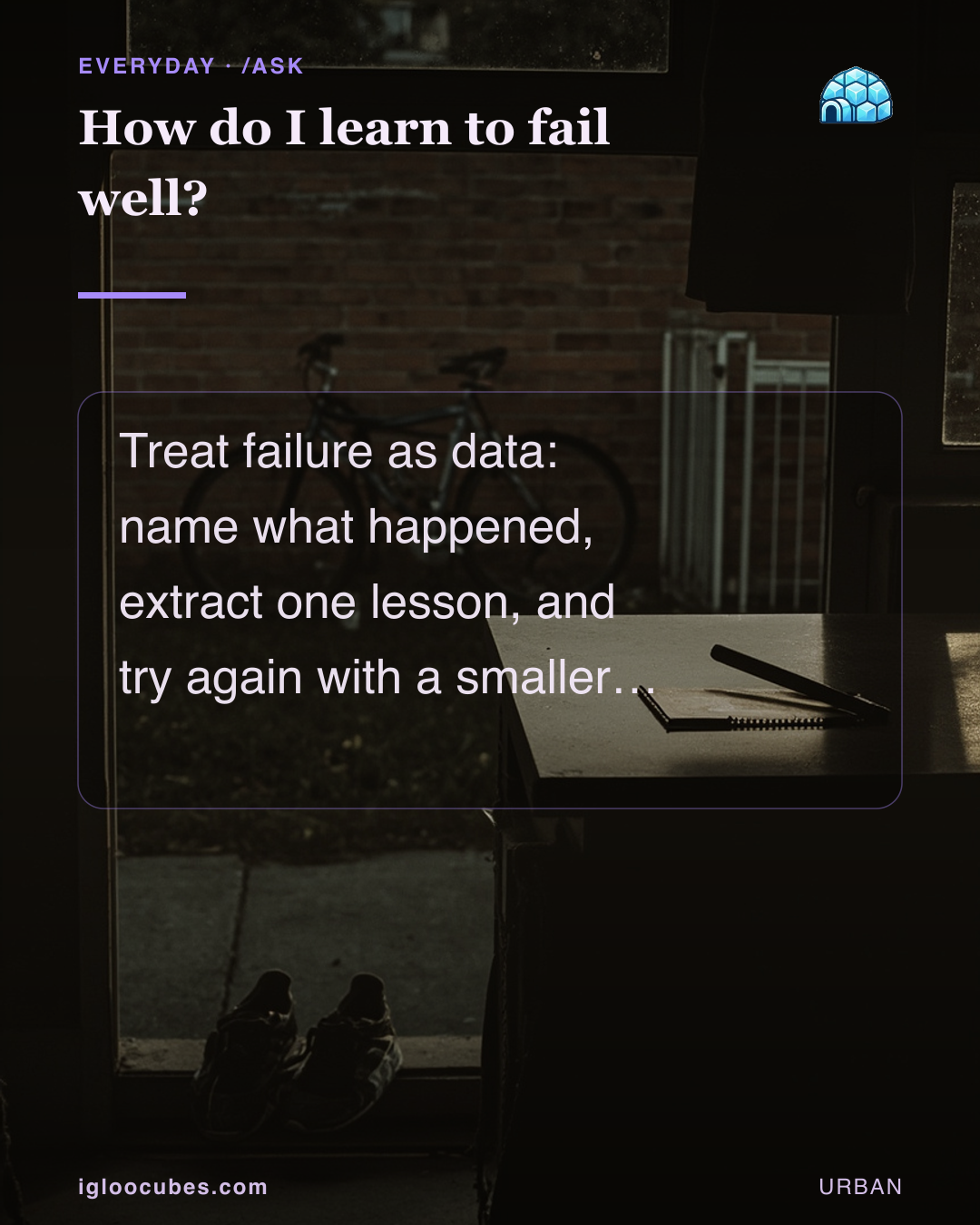
Failing well means making the failure specific enough that you can learn from it. The useful move is not to wallow in it or pretend it was fine. It is to name the mismatch between what you expected and what actually happened, then change one thing before the next attempt.
Research on learning from errors points to the same basic loop: identify the failure, analyze why it happened, and then try again with feedback. That works better when the next attempt is small enough to be informative. A tiny experiment gives you a cleaner signal than a huge, emotional do-over.
So the shortest version is: write down the lesson, separate the mistake from your identity, and make the next try more deliberate. Failure is only useful if it becomes a better decision the next time around.
Sources
More in Everyday
Can family actually feel like freedom?
Yes — when family is structured as a secure base of mutual support rather than a scoreboard of obligations, the safety of having backup allows you to explore the world with less fear of carrying the load alone.
💡 Everyday 1 week ago 3 min readCan Stoic philosophy help resist corruption?
Stoicism can strengthen personal integrity by making small moral compromises harder to rationalize, but it cannot replace institutional rules and oversight.
💡 Everyday 1 week ago 3 min readDoes caregiving change what masculinity looks like?
Caregiving changes masculinity less by theory than by practice, because responsibility, patience, and consistency become part of the role.
💡 Everyday 4 weeks ago 3 min read