
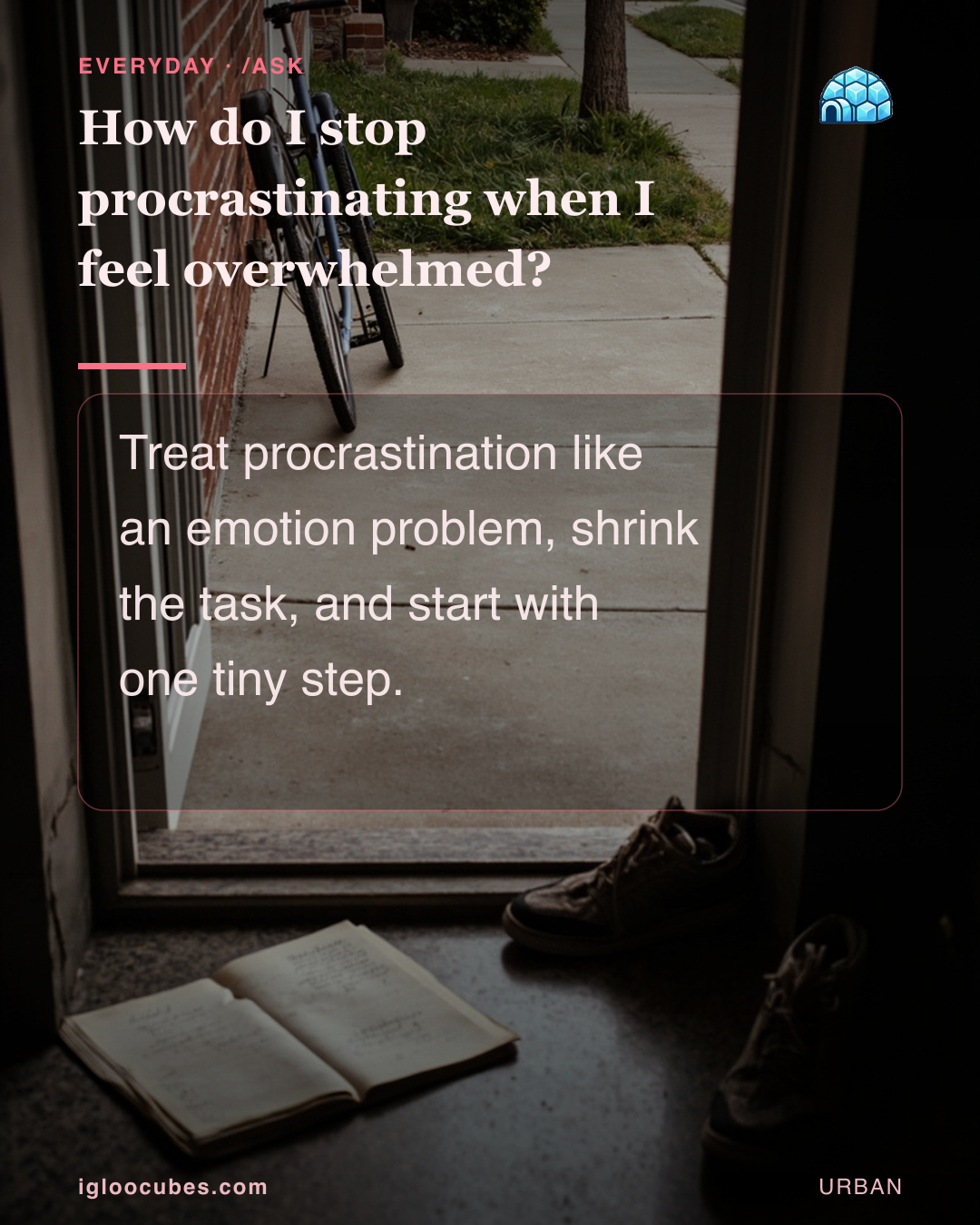
Procrastination usually is not laziness. APA describes it as an emotion-regulation problem: the task feels unpleasant, so delaying it gives short-term relief. The trouble is that the relief is temporary, and the pressure grows later.
The fix is to make starting feel safer. Shrink the task to something you can do in 10 minutes, remove one source of friction, and begin before you feel ready. If the first step is tiny enough, momentum does the rest.
It also helps to pick one tool, one place, and one time. A simple timer can make the work feel finite instead of endless, which is often the part that triggers avoidance in the first place.
If a visual timer helps you stay honest about the first 10 minutes, this kind of simple desk timer can be enough: Pomodoro timer for desk.
So the goal is not to solve the whole project in one burst; it is to make the first move so small that your brain stops arguing with it.
One useful trick is to define “done for now” before you begin. If you know the task only has to move one inch instead of becoming perfect, starting gets much easier because the first step no longer threatens to become a whole afternoon. That little boundary keeps overwhelm from turning into a vague, open-ended dread.
If the task still feels huge, write the first three actions on paper and ignore the rest until those are done. The point is to reduce mental load, not to prove that you can think your way through the entire project before touching it. Small progress is what interrupts the freeze.
Sources
More in Everyday
Can family actually feel like freedom?
Yes — when family is structured as a secure base of mutual support rather than a scoreboard of obligations, the safety of having backup allows you to explore the world with less fear of carrying the load alone.
💡 Everyday 1 week ago 3 min readCan Stoic philosophy help resist corruption?
Stoicism can strengthen personal integrity by making small moral compromises harder to rationalize, but it cannot replace institutional rules and oversight.
💡 Everyday 1 week ago 3 min readDoes caregiving change what masculinity looks like?
Caregiving changes masculinity less by theory than by practice, because responsibility, patience, and consistency become part of the role.
💡 Everyday 4 weeks ago 3 min read