
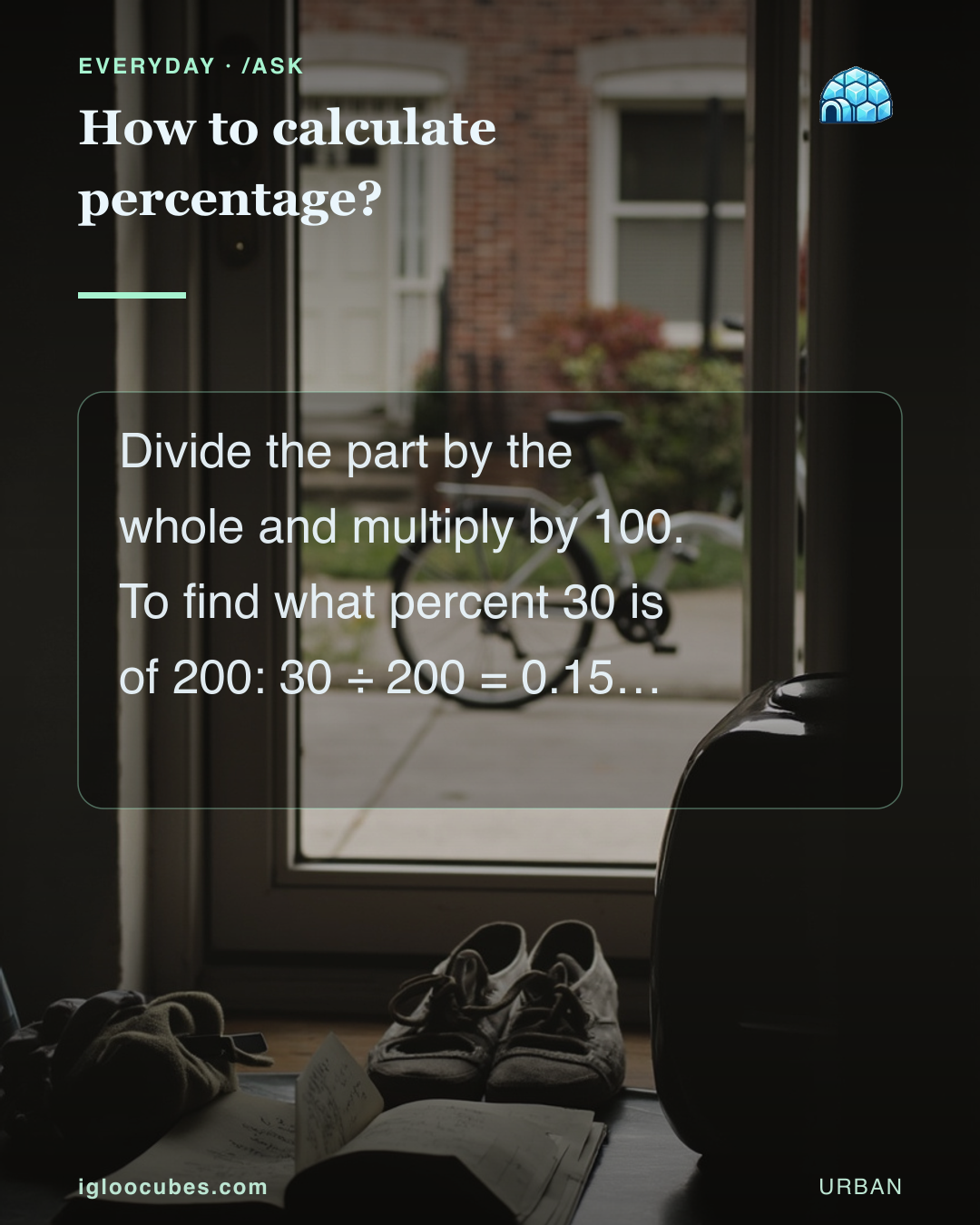
There are three main situations you’ll run into, and each has its own quick formula.
Finding what percent one number is of another. Divide the part by the whole, then multiply by 100. If you scored 42 out of 60 on a test: 42 ÷ 60 = 0.7, then 0.7 × 100 = 70%.
Finding a percentage of a number. Convert the percentage to a decimal, then multiply. To find 15% of 80: 15 ÷ 100 = 0.15, then 0.15 × 80 = 12. A faster shortcut for common percentages: 10% is simply moving the decimal point one place left (10% of 80 = 8), and 5% is half of that.
Finding the whole when you know the part and the percentage. Divide the part by the percentage (as a decimal). If you paid $45 in tax and that was 6% of the total price: 45 ÷ 0.06 = $750.
For quick mental math, start with 10% and adjust. Need 20% of $65? 10% is $6.50, double that to get $13. Need a 15% tip on a $48 bill? 10% is $4.80, half of that (5%) is $2.40, add them together for $7.20.
More in Everyday
Can family actually feel like freedom?
Yes — when family is structured as a secure base of mutual support rather than a scoreboard of obligations, the safety of having backup allows you to explore the world with less fear of carrying the load alone.
💡 Everyday 1 week ago 3 min readCan Stoic philosophy help resist corruption?
Stoicism can strengthen personal integrity by making small moral compromises harder to rationalize, but it cannot replace institutional rules and oversight.
💡 Everyday 1 week ago 3 min readDoes caregiving change what masculinity looks like?
Caregiving changes masculinity less by theory than by practice, because responsibility, patience, and consistency become part of the role.
💡 Everyday 4 weeks ago 3 min read