
🧊 The Iceberg
money
Paying Debt vs Saving — The Full Tradeoff
Should you pay off debt or save? The answer depends on interest rates, timelines, psychology, and risk tolerance. Here's a framework for deciding — avalanche, snowball, or something in between.
Few financial questions are as personal — and as misunderstood — as “should I pay off debt or save?” The answer sounds like it should be simple. It isn’t.
The math says prioritize the highest-interest debt first. But humans don’t always follow the math, and for good reason: behavior, psychology, and risk matter as much as the APR on your credit card. Meanwhile, the retirement savings landscape has been quietly transformed by automatic enrollment, target-date funds, and the SECURE 2.0 Act — making it easier than ever to save without thinking about it.
Here’s how to think about the tradeoff, what has changed in the retirement system, and how to make a decision that actually sticks.
The debt payoff decision: avalanche, snowball, or hybrid
The avalanche method prioritizes debts by interest rate — highest APR first, regardless of balance. Mathematically, it saves the most money over time because you’re eliminating the most expensive debt fastest. If you have a credit card at 24% APR and a car loan at 6%, every dollar you put toward the card saves you more interest than a dollar toward the car.
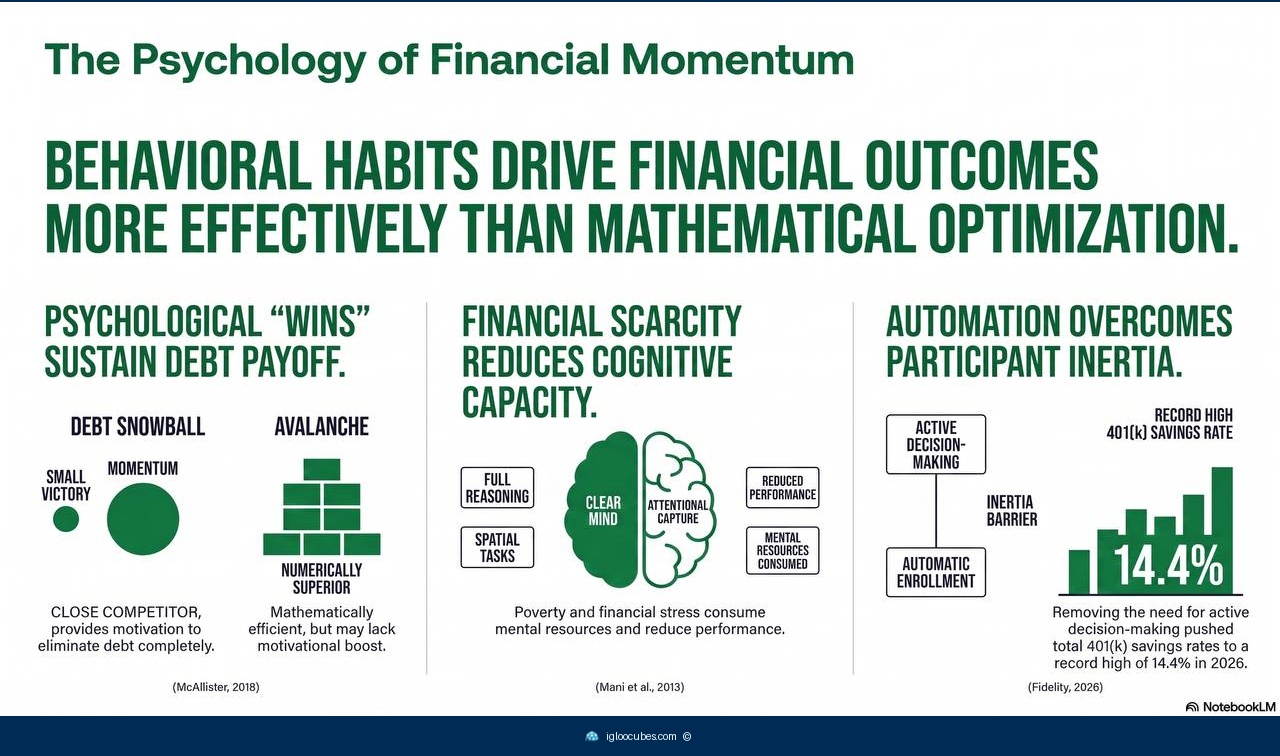
The snowball method prioritizes debts by balance — smallest first, regardless of interest rate. It’s mathematically suboptimal, but it works because of momentum. Clearing a small balance gives you a psychological win that keeps you motivated. McAllister (2018) and other behavioral research show that the feeling of progress matters more than the absolute savings rate for many people — especially those juggling multiple debts.
The hybrid approach splits the difference: attack high-interest debt first (avalanche) but carve out a small “quick win” budget to clear one tiny balance early for the psychological boost. This is the practical sweet spot for most people.
Which one is right for you? If you’ve been trying to pay off debt for more than six months and keep losing motivation, snowball is probably better — even if it costs you a few extra dollars in interest. If you’re disciplined and can stick with a plan, avalanche saves more. The best method is the one you’ll actually follow.
When saving wins over paying debt
The conventional wisdom says “pay off debt before you save.” That’s wrong in three important scenarios.
1. Employer-matched retirement contributions. If your employer offers a 401(k) match, contributing enough to get the full match is almost always the right move — even if you have high-interest debt. The match is an instant 50-100% return on your money. Nothing in the debt world beats that. The math is clear: contribute at least enough to get the match. Then throw everything else at debt.
2. No emergency fund. If you have no savings at all and an unexpected expense would push you onto a credit card, build a small emergency fund ($1,000-2,000) before accelerating debt payments. Otherwise, an emergency becomes new debt at a higher rate than the debt you’re paying down.
3. Low-interest, fixed-rate debt. A 3% mortgage or a 4% student loan isn’t an emergency. If your debt is cheap and fixed, it’s often better to invest the difference than to prepay. Historical market returns average 7-10% — the spread between that and cheap debt is money in your pocket over time.
How retirement savings has changed
The entire retirement savings system has been redesigned around behavioral psychology — and it’s working.
Automatic enrollment is now mandatory. Starting in 2025, all new 401(k) and 403(b) plans with more than 10 employees must auto-enroll new hires and automatically escalate their contribution rates over time. Under voluntary enrollment, only 28% of new hires participated. Under automatic enrollment, that number triples to 91%.
The numbers are getting serious. For 2026, the standard employee deferral limit is $24,500, and the total contribution limit (employee plus employer) is $72,000. Workers aged 60-63 can contribute an extra $11,250 in catch-up contributions under the new SECURE 2.0 “super catch-up” provisions.
The Roth catch-up mandate. Starting January 2026, participants age 50 or older who earned more than $150,000 in the previous year must make their catch-up contributions to a Roth (post-tax) account rather than a pre-tax traditional account. This shifts the tax benefit from now to later — good for long-term tax diversification, but a real change for high earners planning their cash flow.
The bigger picture: what the data shows
The major recordkeepers track how Americans actually save, and the picture reveals real differences by income level.
Vanguard’s 2026 How America Saves report found the average participant deferral rate was 7.6%, with total savings (including employer match) of 12.1%. Fidelity’s Q1 2026 data shows an average employee savings rate of 9.6% and total savings of 14.4%. The difference reflects their different client bases — Vanguard serves more small and mid-size plans, Fidelity more large corporate plans. Average account balances also differ: $167,970 at Vanguard versus $141,000 at Fidelity.
Lower-income participants face harder tradeoffs. Those earning under $100,000 are about 3.5 times more likely to take hardship withdrawals than higher earners, primarily to avoid eviction or pay medical expenses. The SECURE 2.0 Act made it easier to tap retirement funds for emergencies — but nearly half of those who take a hardship withdrawal take multiple distributions in a year, effectively treating their 401(k) as an emergency savings fund. That undermines long-term retirement readiness, even though it solves an immediate problem.
Small businesses still lag. Small employers have historically trailed large corporations by 50 percentage points in adopting automatic enrollment. The SECURE 2.0 mandate for plans with more than 10 employees is designed to close this gap, but the transition is still underway.
Company stock is a hidden risk. Some employers make matching contributions in company stock rather than cash. Plans with stock-based matching see an average of 19% of plan assets tied up in that stock, compared to just 6% when matched in cash. That concentration creates a double risk: if your employer hits hard times, you could lose both your job and a chunk of your retirement savings at the same time.
Where the sources disagree
The Vanguard vs Fidelity data gap isn’t a contradiction — it reflects real differences in the populations they serve. But it’s a reminder that national averages hide more than they reveal. Your specific plan’s features, match formula, and participant demographics matter more than the national trend line.
Hardship withdrawal access is genuinely contested. Making it easier to access retirement savings for emergencies provides real liquidity for people in crisis. But the data on repeat withdrawals suggests the policy may create a behavioral trap — solving today’s problem at the expense of tomorrow’s security.
Company stock matches are defended by some employers as an ownership culture tool. But the diversification argument is overwhelming: you already depend on your employer for your income. Adding concentrated stock risk on top of that makes your financial life dangerously dependent on one company’s performance.
The bottom line
The “debt vs savings” question doesn’t have one answer because it’s really several questions layered together:
- Do you have high-interest debt? Attack it, probably avalanche-first unless you need the momentum of snowball.
- Does your employer offer a 401(k) match? Get the match before paying down anything above 7-8% APR. It’s the best return you’ll get anywhere.
- Do you have no emergency fund? Build $1,000-2,000 before accelerating debt paydown. That tiny cushion prevents emergencies from becoming new high-interest debt.
- Is your debt low and fixed? Consider investing the difference. Cheap debt doesn’t have to be eliminated early.
- Are you on the verge of a big life change (buying a house, starting a business)? Liquidity matters. Saving may beat paying down cheap debt.
The behavioral takeaway: the best financial plan is the one you can actually stick with. The math matters, but behavior matters more.