
🧊 The Iceberg
travel
Solo Travel and Pet Travel — The Two Trends Reshaping How We Move
Traveling alone and traveling with pets are exploding in 2026 — driven by new airline routes, AI planning tools, and a cultural shift toward experiences that fit your actual life instead of a brochure.
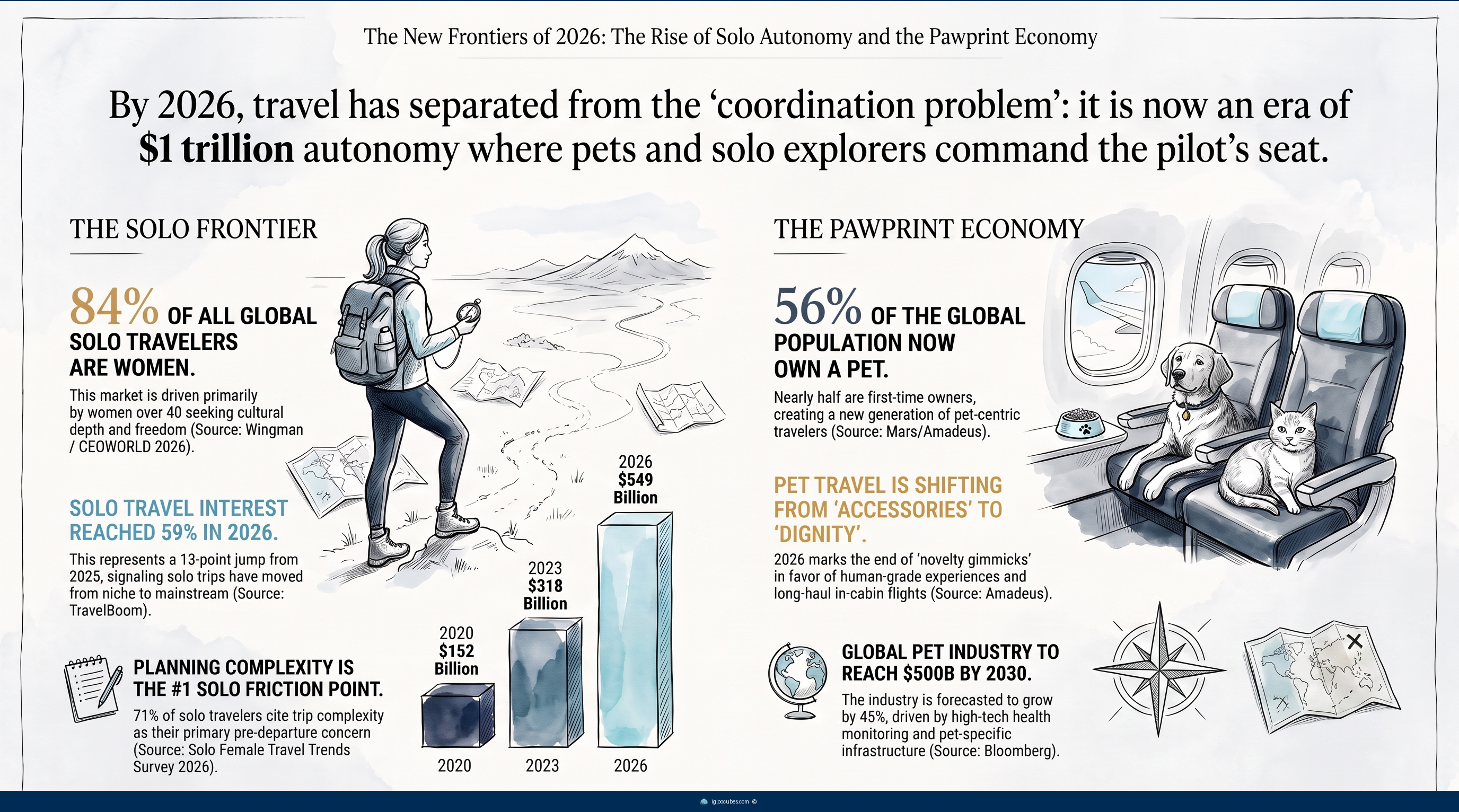
Travel in 2026 looks different than it did five years ago. Two of the biggest shifts are happening at opposite ends of the companionship spectrum — people traveling completely alone, and people refusing to leave their pets behind.
Here’s what’s driving both trends, and what’s actually changing on the ground.
Solo travel has hit the mainstream
Traveling alone used to be painted as something you did in your twenties with a backpack, or out of necessity. That’s changed. Solo travel is now a multi-billion-dollar market driven by people who value freedom and flexibility over waiting for someone else’s schedule.
The numbers back it up. Wingman reports that solo travel hit an all-time high in 2026. Women make up 84% of solo travelers globally, and women over 40 are the fastest-growing segment. They’re not looking for hostels — they want solo-friendly hotels, curated group tours for one, and destinations where eating alone at a restaurant feels normal. Among experienced solo travelers, 37% have completed more than ten solo trips.
The reasons are practical too. More people live alone than ever. Remote work means trips don’t require burning vacation days. And for many travelers, the idea of compromising on a destination just to have company no longer makes sense.
Airlines and hotels have noticed. Single-occupancy rooms are more common, and some airlines are adjusting pricing to close the “single supplement” gap — the extra charge solo travelers have historically paid for occupying a room alone.
Pets are now first-class travelers
The way people think about pets and travel has shifted hard. 56% of people globally own a pet, and nearly half are first-time owners. A pet is no longer something you board at a kennel. More travelers are bringing them along, and the industry is catching up.
Italy’s aviation authority, ENAC, now allows medium and large dogs to fly in the passenger cabin instead of cargo. The UK reinstated its pet passport system, letting British travelers take pets to Europe without expensive single-use health certificates. SkyePets launched the first transpacific in-cabin pet flights between Australia and the U.S., so even long-haul travelers don’t have to choose between their destination and their animal.
Even mid-range hotels now treat pet amenities — beds, bowls, relief areas — as standard rather than an upcharge. The trend is sometimes called the “pawprint economy,” and airlines are competing on pet policies the way they used to compete on legroom.
AI is changing how people plan — but not replacing human judgment
More travelers are using AI to build trip itineraries. Instead of reading through a dozen blog posts, you can describe your preferences — “five days in Portugal, focus on food, moderate budget, traveling alone” — and get a detailed plan in seconds.
TravelBoom’s study shows AI planning usage jumped 25 points to 63%. Amadeus reports a 64% year-over-year surge in travelers planning with generative AI. Google’s multimodal search and Expedia’s Trip Matching (which turns Instagram reels into full itineraries) are both examples of AI making trip planning faster.
But here’s the tension: only 46% of consumers say they trust AI systems, and 25% have received outdated or inaccurate information from AI tools. The winning approach is mixed — use AI for the broad strokes and price comparisons, then verify recommendations against human reviews on social media, Reddit, or travel forums. The trust deficit is actively driving a counter-movement toward human-curated platforms.
Second cities are suddenly reachable
New single-aisle jets with extended range — like the Airbus A321XLR, which started deliveries in late 2025 — are changing where you can fly nonstop. Airlines are deploying them on routes to smaller, lesser-known cities that used to require a connection through a major hub. Airlines benefit from 25-30% fuel efficiency gains, making these thinner routes profitable.
It matters most for solo travelers, who are more willing to skip the obvious destinations and go straight to a place that matches their interests. It also matters for repeat travelers who want something new without a three-flight itinerary.
New airports are opening too. Cambodia’s Techo International Airport opened its biophilic terminal in October 2025. Vietnam’s Long Thanh Airport is scheduled for 2026. These aren’t just new buildings — they’re new gateways that reshape which cities are convenient to visit.
Pop culture is driving destination choices
More people are planning trips around movies, TV shows, and fan events — a trend called “pop culting.” Visit the filming locations of a favorite show. Attend a specialized fan convention. Go to a specific place because it’s featured in content you love.
South Korea is the most visible example, driven by K-drama and K-pop tourism. But small towns in Canada, New Zealand, and the U.S. have all seen tourism spikes after being featured in popular series. This trend is especially strong among solo travelers, who are more likely to build a trip around a personal interest rather than a group consensus.
Hotels are unbundling the room
The old model of “standard room” vs. “suite” is fading. Hotels are moving toward unbundled systems where you pick the specific features you want — a room with workout equipment, soundproofing, a gaming console — and pay only for what you choose. 12% of Gen Z travelers are willing to pay up to 25% more for a room with an Xbox or premium TV. 17% of U.S. business travelers will pay 20% more for bundled business services like in-room printing.
This shift is possible because of technology integrations like the Amadeus and Shiji partnership (announced September 2025), which created the digital infrastructure for hotels to offer hyper-personalized room configurations at scale.
For solo travelers, it means not paying for a second bed or a giant bathroom you don’t need. For pet travelers, it means choosing a room designed for pets rather than hoping for the best at check-in.
Who’s affected and how
Solo travelers get better pricing, more accommodation options designed for one person, and destinations that assume you’re traveling alone by choice, not circumstance. Women over 40 — the fastest-growing segment — care most about cultural depth: food, history, walking. They worry less about safety than younger groups.
Pet owners get real regulatory changes — dogs in cabins instead of cargo, cross-border pet passports instead of costly certificates, and even transpacific options for the first time. Those leaving pets at home can use AI-driven tech like biometric tracking collars with 24/7 tele-health.
Gen Z and Millennials lead on digital-first travel. They use YouTube, TikTok, and Instagram for inspiration, AI for planning, and are willing to pay for experiential upgrades in their rooms.
Business travelers use personalization to create optimized workspaces — paying more for in-room printing and business services.
Hotels and airlines are adapting to shorter stays, tighter booking windows, and a consumer base that expects personalization. Hotels are monetizing features they never charged for separately.
What’s still unsettled
The AI trust gap. Usage is skyrocketing, but trust is lagging. People use AI to plan but then cross-check everything on Reddit. The industry hasn’t figured out how to close that gap.
Why the pet surge happened. Is it people replacing long-term relationships? Pet owners testing themselves before having kids? The rise of pet ownership is clear, but the cause is debated.
Overtourism. Two-thirds of travelers say they’d avoid an overcrowded destination. But controlling crowds with permits, timed entry, and visitor limits creates its own problems. There’s no clean solution.
Futuristic travel timelines. 60% of consumers are interested in hypersonic air travel and 59% in hyperloop ground transit. But neither is commercially real yet, and their rollout timelines are anyone’s guess.
The bottom line
The travel industry is finally adapting to how people actually live. Solo travelers are being treated as a legitimate market instead of an afterthought. Pet owners no longer have to choose between traveling and their animals. AI is making planning faster without replacing human judgment. And smaller cities are becoming real alternatives to overcrowded capitals.
If you’ve been putting off a trip because you don’t have someone to go with, or because you didn’t want to leave your pet — the industry is catching up to both of those reasons this year.