
💎 Crystal
pets
Dog Years — The 1-to-7 Rule Is Wrong. Here's the Real Math.
The old 'one human year equals seven dog years' myth doesn't hold up. Size, breed, and life stage matter more than simple multiplication.
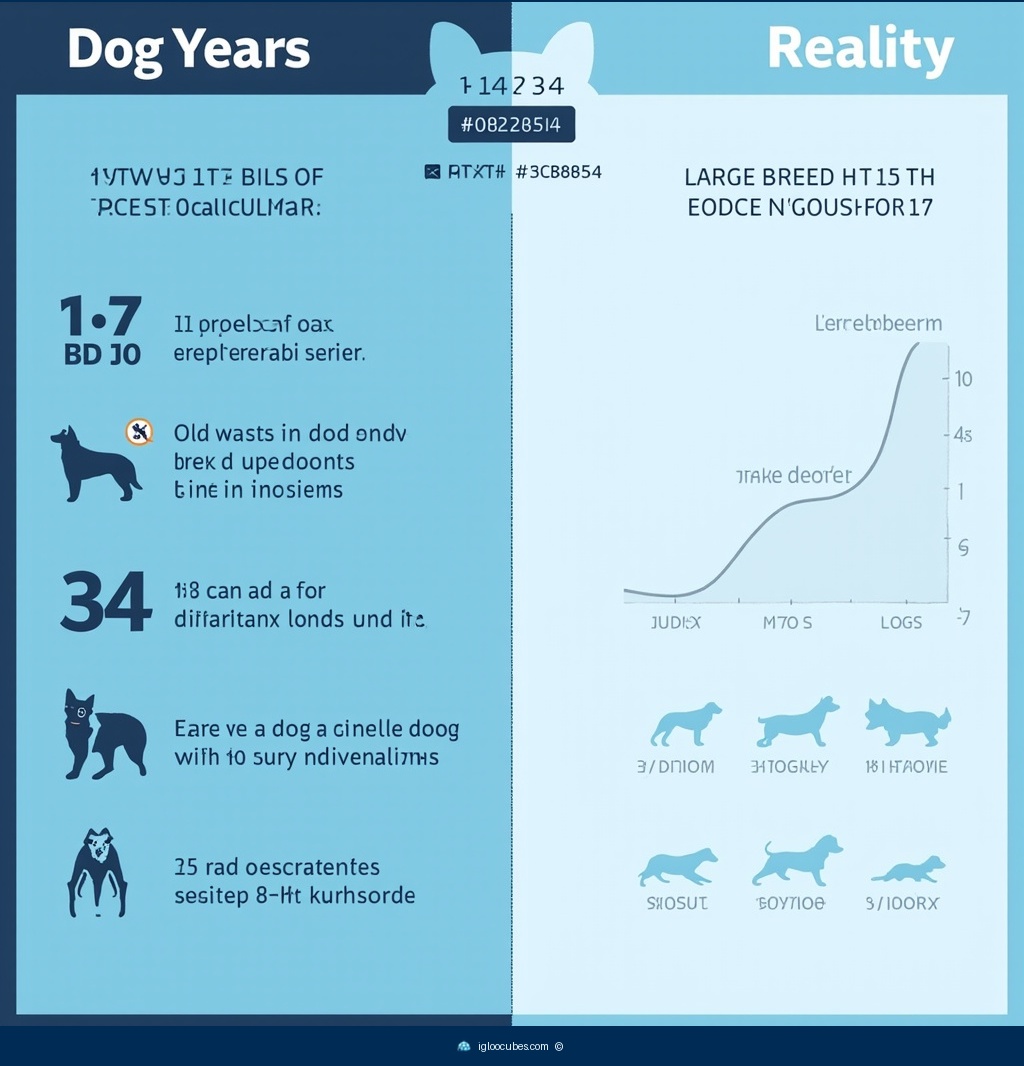
- The 1-to-7 rule is a rough simplification that doesn't match how dogs actually age. A 1-year-old dog is closer to a 15-year-old human, not a 7-year-old.
- Small breed dogs live longer and age more slowly — a 10-year-old Chihuahua is roughly equivalent to a 55-year-old human, while a 10-year-old Great Dane is equivalent to an 80-year-old human.
- The first two years of a dog's life account for the most rapid aging. After that, the rate slows and varies by breed size.
- Rather than converting 'dog years,' veterinarians look at life stage — puppy, adolescent, adult, senior — to determine the right care and diet for each phase.
Almost everyone has heard the rule: one human year equals seven dog years. It’s simple, memorable, and almost completely wrong.
Where the 1-to-7 myth came from: Nobody knows for sure, but the leading theory is that it was based on the average human lifespan (about 70 years at the time) divided by the average dog lifespan (about 10 years). It was never based on biology.
The real aging curve is nonlinear. A one-year-old dog is developmentally equivalent to a 15-year-old human — fully capable of reproduction but still in adolescence. By year two, that dog is roughly equivalent to a 24-year-old human. After that, the rate slows to about 4 human years per dog year for small breeds and 6 to 7 for large breeds.
Size matters more than age. Small breeds (under 20 pounds) often live 12 to 16 years. Medium breeds average 10 to 13. Large breeds (over 50 pounds) average 8 to 12. Giant breeds like Great Danes rarely pass 10. A 7-year-old Labrador is a senior dog. A 7-year-old Pomeranian is middle-aged.
The practical takeaway: Stop using the 7-year rule. If your dog is over 6, ask your vet about senior wellness checks regardless of breed. If your dog is a large breed, start those checks at age 5. The conversion doesn’t matter — the life stage does.