
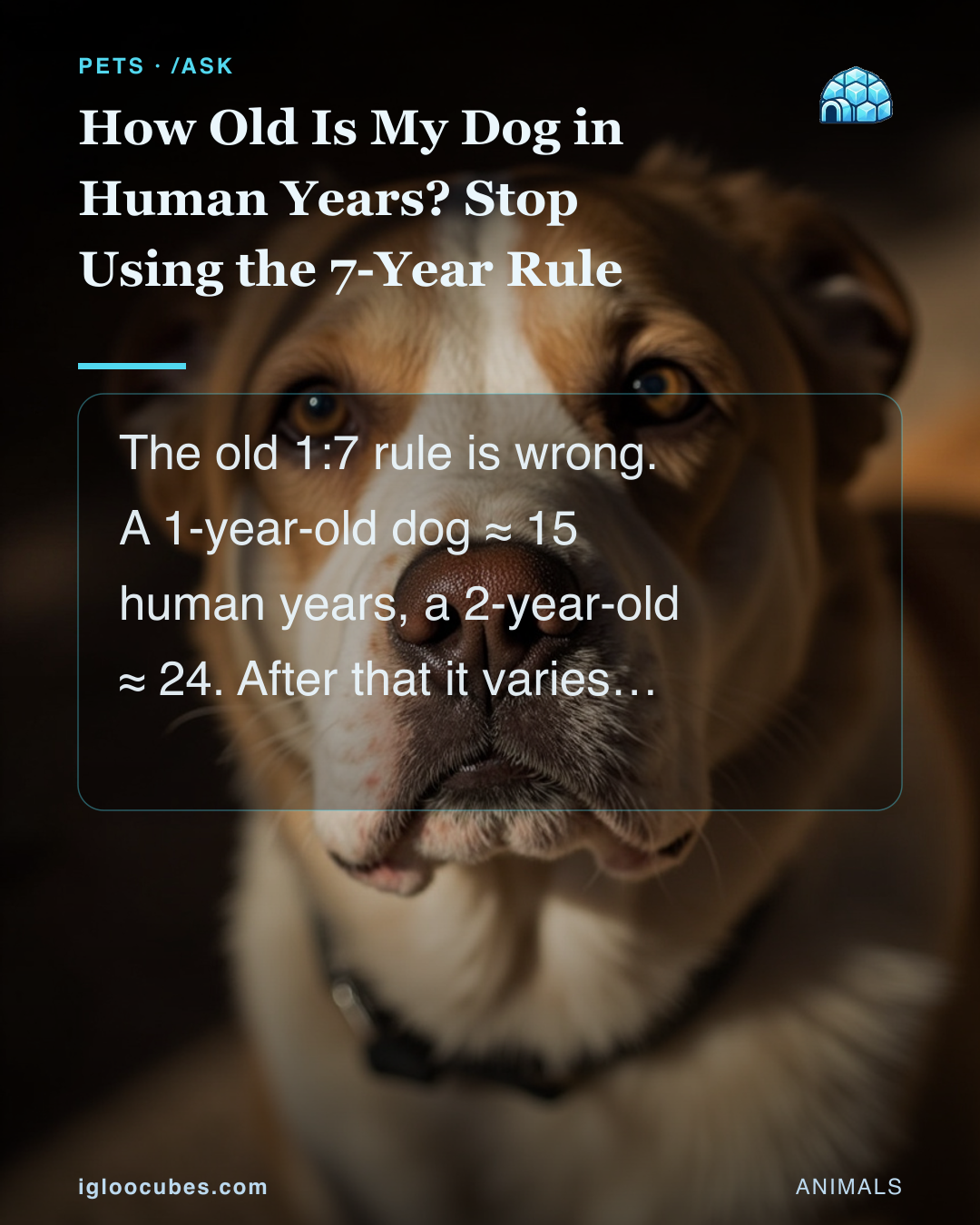
If you’re still dividing your dog’s age by 7, you might be way off.
The real conversion looks like this:
- Year 1 ≈ 15 human years (adolescent, can reproduce)
- Year 2 ≈ 24 human years (fully mature young adult)
- Year 3+ varies by breed size
Breed size matters more than calendar years:
- Small breeds (under 20 lbs): About 4 human years per dog year after age 2. A 10-year-old small dog ≈ 55 human years.
- Medium breeds (20–50 lbs): About 5–6 human years per dog year.
- Large breeds (over 50 lbs): About 6–7 human years per dog year. A 10-year-old large dog ≈ 80 human-years equivalent.
Why it matters. A 6-year-old Labrador is a senior dog and should start getting senior wellness bloodwork. A 6-year-old Pomeranian is still middle-aged. Using the wrong age calculation means you might miss the right timing for diet changes, joint supplements, or health screenings.
Simplest rule: Stop converting. Ask your vet about senior care at age 6 for most dogs, or age 5 for large and giant breeds.
Sources
Want the full picture?
Dog Years — The 1-to-7 Rule Is Wrong. Here's the Real Math.
The old 'one human year equals seven dog years' myth doesn't hold up. Size, breed, and life stage matter more than simple multiplication.
More in Pets
Do I need pet insurance?
Pet insurance makes sense if an unexpected vet bill would strain your budget, especially while your pet is still healthy.
🐾 Pets 5 weeks ago 2 min readDo indoor cats need flea prevention?
Often, yes. Indoor cats can still pick up fleas from dogs, people, other animals, or a contaminated home.
🐾 Pets 4 weeks ago 2 min readHow can I tell if my cat is depressed?
A depressed or stressed cat may hide, eat less, sleep more, groom less, or stop playing, but medical causes can look the same.
🐾 Pets 3 weeks ago 3 min read