
💎 Crystal
science
The Simulation Argument — Are We Living in a Computer Simulation?
Bostrom's trilemma says one of three is true: humanity goes extinct before running simulations, advanced civilizations choose not to, or we are almost certainly living in one.
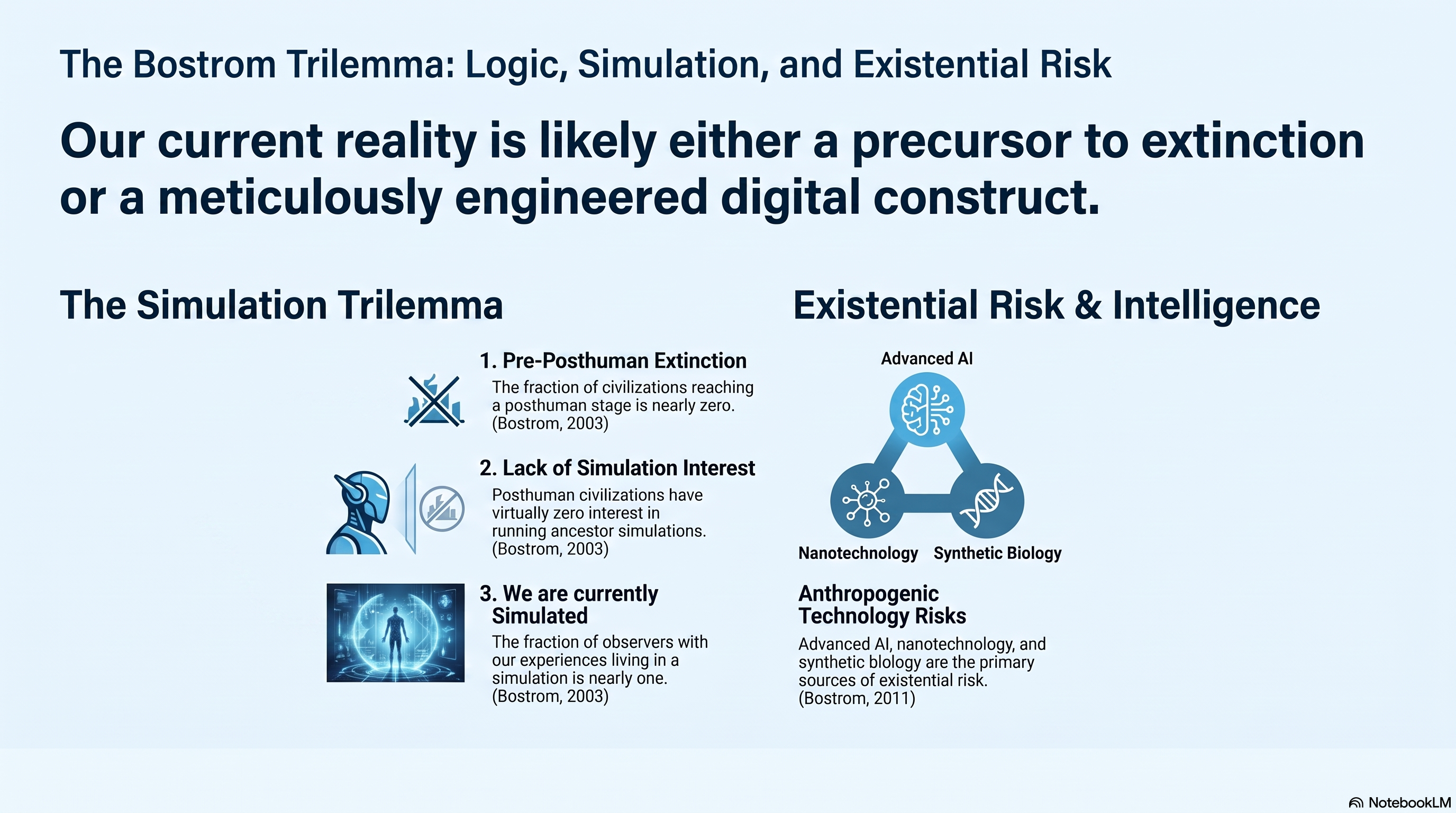
- Bostrom's trilemma: at least one of three must be true — extinction before simulations, ethical disinterest in running them, or we are almost certainly simulated.
- The argument doesn't claim to know which is true. It forces you to choose between three uncomfortable options.
- Critics point to the exponential computational cost of nested simulations and the missing variable Q (number of actual civilizations).
- The simulation argument is best understood as a constraint on what we can rationally believe, not a claim about reality.
The simulation argument is not a theory about aliens or futuristic video games. It’s a logic problem first published by Oxford philosopher Nick Bostrom in 2003, and it has generated more discussion than almost any other philosophical argument of the past two decades.
Bostrom’s trilemma
Bostrom argues that at least one of three propositions must be true:
1. The extinction rate of human-level civilizations is very high. Almost all civilizations that reach a technological stage capable of running realistic ancestor simulations go extinct before they get there. This could be from AI, war, biotechnology, or any of the existential risks Bostrom has spent his career studying.
2. Civilizations that reach this stage are extremely unlikely to run simulations. Even if they survive, they choose not to create simulations of their ancestors — perhaps for ethical reasons, perhaps because they lose interest, perhaps because they have better things to do.
3. We are almost certainly living in a simulation. If the first two are false, then the number of simulated minds would vastly outnumber the number of biological minds. A posthuman civilization running even a modest number of ancestor simulations could produce billions of simulated conscious beings for every one biological human.
Bostrom doesn’t claim to know which of these is true. His point is that you can’t reject all three. At least one must hold.
The counterarguments
The simulation argument has drawn serious philosophical criticism. The most detailed mathematical refutation comes from Brady Cook (2021), who argues that Bostrom made a critical error by omitting a key variable: the actual number of civilizations that exist in the universe.
The simplicity assumption. Cook argues that nested simulations — a simulated civilization that builds its own simulated civilization — create a computational burden that grows exponentially. If simulations can run their own simulations, the processing power required at the top level becomes astronomically large. This creates a “reductio ad absurdum”: if simulations are common, the computing requirements at the base level are physically impossible.
The Q variable. By introducing the actual number of civilizations into the equation, Cook shows that the probability of being simulated depends heavily on assumptions about how many civilizations exist. In a universe with few civilizations, the simulation argument loses much of its force. In a universe with many, it becomes more plausible but faces the computational limits problem.
The ethical barrier. A separate line of criticism suggests that future civilizations would face overwhelming ethical objections to running simulated worlds containing conscious, suffering beings. If consciousness is real in the simulation, the ethical calculus against running one is substantial.
So are we in a simulation or not?
The honest answer is: we don’t know, and Bostrom’s argument doesn’t claim to tell us. What it does is narrow the possibilities to three, forcing you to confront uncomfortable implications no matter which one you pick.
The simulation argument is best understood not as a claim about reality, but as a demonstration of how probability, anthropic reasoning, and assumptions about the future constrain what we can rationally believe about our own existence. Whether you think we’re simulated or not, thinking through the argument changes how you think about everything else.