
🧊 The Iceberg
science
Psychic Spies and Consciousness Frontiers — Remote Viewing, the Stargate Project, and the CIA's Gateway Document
For 25 years the U.S. government secretly investigated whether the human mind could perceive hidden targets across the globe. The Stargate Project, the Monroe Institute, and the CIA's declassified Gateway document sit at the center of a debate that refuses to settle.
In 2023, the CIA released a document written in 1983 analyzing whether a training program called the Gateway Experience could be used to induce out-of-body states for intelligence gathering. By 1995, the government had already spent $20 million on a program called the Stargate Project investigating whether “remote viewing” — describing hidden targets without using the senses — was a usable intelligence tool.
The internet went wild over the Gateway document. Most of what went around was wrong. But the actual story — what the government actually studied, what they found, and what remains genuinely unexplained — is more interesting than either the hype or the debunk.
1. The Tip of the Iceberg (Widely Accepted Facts)
These are the historically documented, publicly declassified facts that no serious researcher disputes.
What is remote viewing? Officially labeled “anomalous cognition” in laboratory literature, remote viewing is a structured perceptual protocol where a participant attempts to describe or sketch a target completely shielded from ordinary sensory access. It’s not fortune-telling or mediumship — it follows a defined, repeatable procedure.
The Stargate Project. Established in 1977 at Fort Meade, Maryland, Stargate was a secret U.S. Army unit overseen by the DIA and CIA. Comprising 15 to 20 individuals operating out of a wooden barracks, it spent over two decades investigating whether psychic functioning could produce usable intelligence. It was terminated and declassified in 1995.
Robert Monroe and the Monroe Institute. An American researcher and businessman who founded the Monroe Institute in Virginia in 1974, dedicated to exploring fringe ideas about human consciousness. Monroe developed and patented “Hemi-Sync” (Hemispheric Synchronization), an auditory brain-entrainment technology designed to induce altered states.
The Gateway declassification event. The 2023 release of LTC Wayne McDonnell’s 1983 assessment Analysis and Assessment of Gateway Process became a modern cultural touchstone. The document analyzed whether the Monroe Institute’s training could enable expanded perception — and it was far more measured than the viral takes suggested.
2. Below the Surface (Nuanced Protocols and Early History)
The specific methodologies, key experiments, and formal scientific reviews that defined the programs.
Coordinate Remote Viewing (CRV) protocol. A highly structured, multi-stage methodology developed to minimize “Analytical Overlay” — the left-brain’s tendency to prematurely analyze and distort raw sensory data with conscious imagination. Viewers remained entirely blind to the target and were given only randomized coordinates. The goal was to train the mind to observe before interpreting.
The SRI experiments. The formal genesis of U.S. remote viewing research began in 1972 at the Stanford Research Institute in Menlo Park, California, under physicists Hal Puthoff and Russell Targ. SRI conducted early testing on notable psychics including Uri Geller, Ingo Swann, and Pat Price, drawing significant interest and funding from the CIA and Joint Chiefs.
Ingo Swann’s methodology role. A core pioneer, Swann coined the term “remote viewing.” Frustrated by the limitations of early “beacon” protocols, he pioneered the use of geographical coordinates as a targeting method and painstakingly documented his own mental steps to establish the rigorous, six-stage CRV training protocol still used by practitioners today.
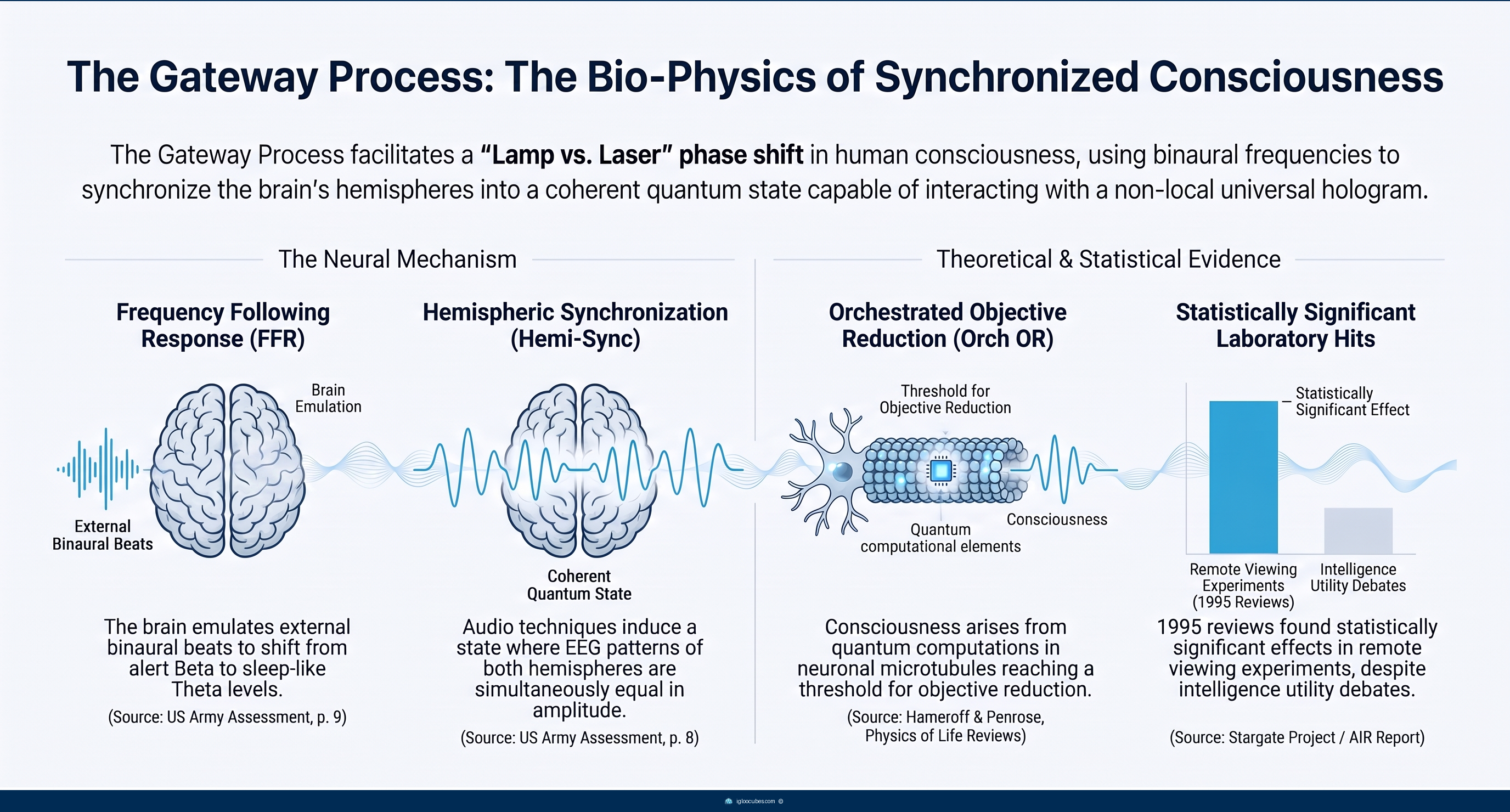
Hemi-Sync and binaural beats. The auditory process plays slightly different sound frequencies into each ear. The brain stem detects the phase differences and integrates them into a third “binaural beat,” triggering a frequency-following response that synchronizes the electrical patterns of both cerebral hemispheres. Mainstream science mostly supports this for relaxation and focus, not psychic ability.
The AIR 1995 report nuance. Commissioned by the CIA, the AIR evaluation is often cited as a definitive debunk. But the full report was more nuanced: it acknowledged that “statistically significant effects were observed in laboratory experiments” while concluding that remote viewing never produced actionable intelligence. The deep divide between evaluators — statistician Jessica Utts arguing ESP was well established, psychologist Ray Hyman arguing it was unproven — remains unresolved.
3. The Deep Water (Theoretical and Statistical Speculation)
The academic parapsychology, quantitative anomalies, and advanced theoretical models.
Quantum consciousness (Orch OR). The “Orchestrated Objective Reduction” theory proposed by Stuart Hameroff and Roger Penrose suggests consciousness consists of discrete moments of quantum state reduction within brain microtubules. The theory connects brain biology directly to the Planck-scale geometry of the universe. It remains highly speculative but has survived peer review in Physics of Life Reviews.
Julian Northey’s source-receiver model. A 2026 theoretical paper proposing that a remote viewing target is not a semantic transmitter but a physical system whose geometry and entropy gradients shape a weak perturbation. This perturbation reaches the viewer’s body, biasing phase-sensitive radical-pair reactions in molecular environments — producing shifts that get reconstructed as drawings. It’s a rare attempt at a falsifiable physical mechanism.
The meta-analyses. Proponents cite decades of controlled trials: ganzfeld ESP studies with a 32% hit rate against 25% chance (odds of 3×10¹⁹ to 1), conscious staring experiments at 54.5% against 50% chance (odds of 8.5×10⁴⁶ to 1), and dice-throwing psychokinesis trials (odds of 2.6×10⁷⁶ to 1). The numbers are striking. The counterargument is that the methodology behind the meta-analyses is not universally accepted.
Remote viewing as a surviving discipline. Despite its 1995 military termination, remote viewing persists through civilian organizations like the International Remote Viewing Association (IRVA) and academic archives such as Rice University’s Archives of the Impossible, which houses Edwin May’s donated collection of declassified Stargate materials.
4. The Abyssal Zone (Fringe Cosmology and Altered Realms)
The most speculative concepts from the Gateway assessment and adjacent research.
The holographic universe theory. Featured heavily in the declassified CIA document, this model combines David Bohm’s concept of the “implicate order” (where the entire universe is enfolded into every part) with Karl Pribram’s “holonomic brain” model. It posits that the universe is a giant, multidimensional hologram of interacting energy fields — and that the synchronized human mind may attune to it.
Monroe’s focus states. Advanced states of cortical arousal induced by Hemi-Sync, designated by numeric levels: Focus 10 (“mind awake, body asleep”), Focus 12 (expanded awareness, consciousness detached from physical constraints), Focus 15 (characterized as timelessness, travel into the past), and Focus 21 (movement outside the boundaries of time-space into “the future”).
The “click-out” phenomenon. A theoretical construct from LTC McDonnell’s assessment, drawing on Itzhak Bentov’s biomedical models. It suggests that when the oscillating frequency of human consciousness accelerates to Planck-scale dimensions, it “clicks out” of physical space-time to join the inactive, infinite energy of “the Absolute.”
The toroidal cosmic spacetime model. The speculative cosmological framework included in the Gateway report. It represents the universe not as a flat expansion but as a multi-dimensional, self-contained spiral torus or “cosmic egg.” Matter is ejected from a “white hole” nucleus, travels along the outer shell as “reality,” and eventually returns to be reabsorbed through a “black hole.”
So where does this leave us?
The honest takeaway is that the government’s 25-year investigation into remote viewing and altered consciousness is more interesting than either true believers or debunkers claim. The Stargate Project produced genuinely puzzling results under controlled conditions. The Gateway document contains real, speculative science that the Army took seriously enough to commission. And the meta-analytical data, while contested, is not easily dismissed as noise.
But none of this proved that remote viewing works as operational intelligence. The AIR evaluators agreed on at least one thing: even if anomalous cognition is real, it was never reliable enough to inform a single decision.
The question that remains open — and that keeps the research alive at places like IRVA, the Monroe Institute, and the Archives of the Impossible — is whether the unreliability is intrinsic to the phenomenon or merely a reflection of how poorly we understand it.
Related reading: Want the shorter takes? Read the individual answers on what remote viewing is, the CIA Gateway Process document, and the Stargate Project deep dive.