
🧊 The Iceberg
science
What the Remote Viewing Project Actually Found — Statistical Evidence, the Operational Verdict, and the Debate That Won't Settle
Stargate ran for 25 years and cost $20 million. The lab results were statistically significant. The operational results were not. Here is what the data actually says, who is fighting over what, and where the honest uncertainty lives.
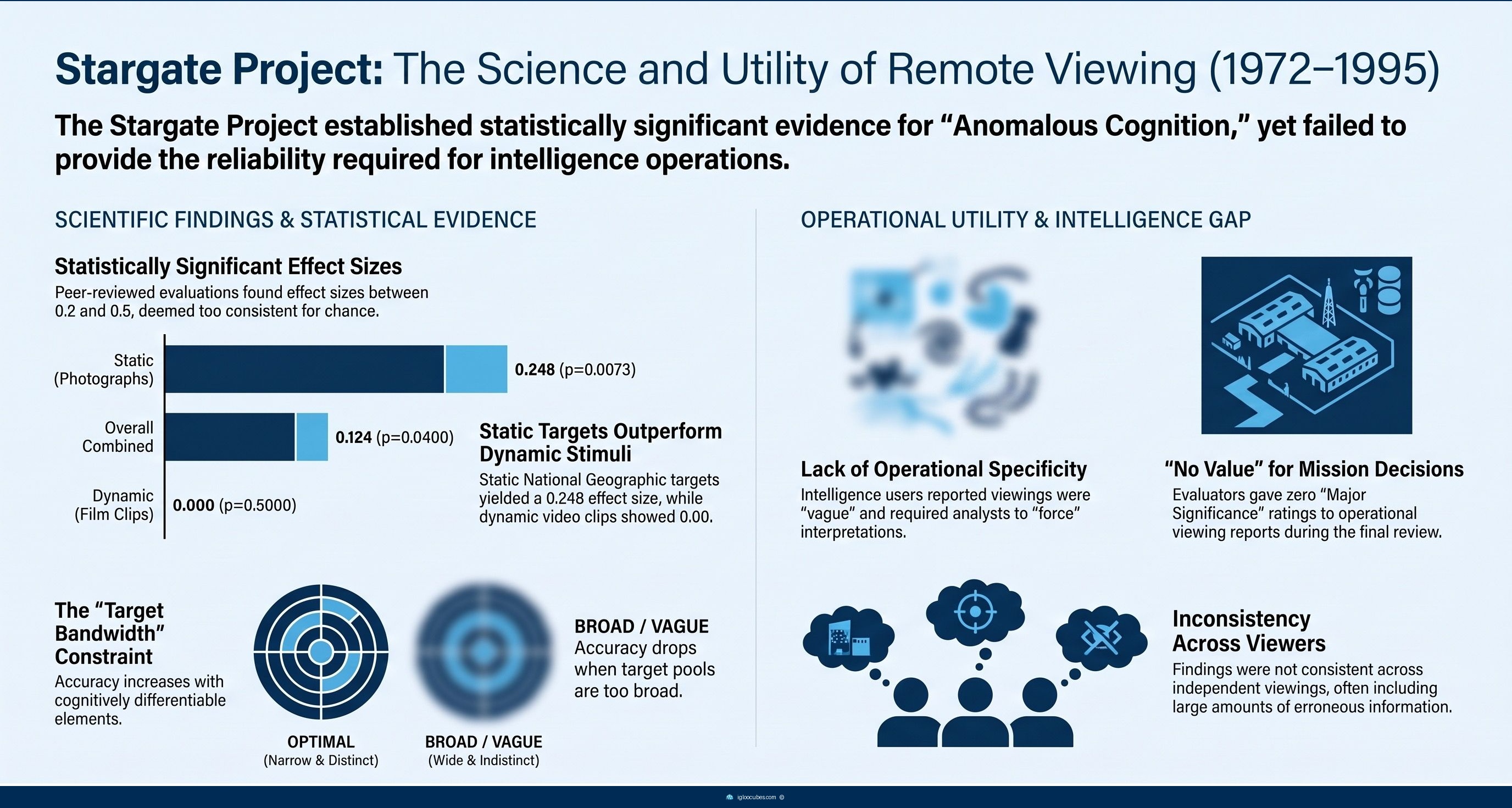
Stargate ran from 1972 to 1995 at a cost of roughly $20 million. The U.S. military used it to ask whether psychic perception could locate hidden Soviet installations, missing spy planes, and hostage sites using only geographic coordinates. The 1995 American Institutes for Research (AIR) review shut the program down — but not for the reason most people think. The data were statistically significant. The output just wasn’t useful. That distinction is the whole argument.
This iceberg is organized in four layers. The top layer is settled history that no serious researcher disputes. The next layer is where the substantive scientific debate lives — the statisticians’ argument over what the lab data actually shows. The third layer is where methodology starts to break down and the operational claims get contestable. The deepest layer is where the Gateway Process goes full fringe: holographic universe theory, consciousness as a wave pattern, and Monroe’s claim to have visited nonphysical spaces like “The Park.”
1. The Tip (Widely Accepted Facts)
These are historically documented, publicly declassified facts that no serious researcher disputes.
What “remote viewing” actually means. Technically labeled “anomalous cognition” in laboratory literature, remote viewing is a structured perceptual protocol where a participant attempts to describe or sketch a target completely shielded from ordinary sensory access. It is not fortune-telling or mediumship — it follows a defined, repeatable procedure.
The Stargate Project. Stargate was a secret $20 million U.S. government research program running from 1972 to 1995 to investigate potential military and domestic intelligence applications of psychic phenomena. It consolidated four earlier programs (Gondola Wish, Grill Flame, Center Lane, and Sun Streak). At its peak the project used over 22 active military and civilian remote viewers; by cancellation that had dwindled to three.
The SRI origin. The scientific groundwork began in 1972 at the Stanford Research Institute, where physicists Hal Puthoff and Russell Targ initiated controlled laboratory experiments. SRI identified talented “star performers” — including Pat Price, Joe McMoneagle, and Ingo Swann — and ran thousands of trials establishing that neither physical distance nor electromagnetic shielding inhibited performance.
Coordinate Remote Viewing (CRV). Pioneered by Ingo Swann, CRV structured casual clairvoyant experimentation into a rigorous six-stage methodology. A viewer was shielded from all sensory clues and provided only the raw latitude/longitude coordinates of a target, then asked to sketch and describe what was located there.
Ingo Swann’s pre-Pioneer-10 demonstration. In 1972, Swann remote-viewed Jupiter before NASA’s Pioneer-10 flyby and identified previously unknown planetary rings. The rings were later confirmed — a result mainstream astronomers initially treated with skepticism.
Robert Monroe. American radio broadcasting executive who popularized “out-of-body experience” (OBE) in his 1971 book Journeys Out of the Body. Founded the Monroe Institute (TMI) in Faber, Virginia, and developed Hemi-Sync audio technology — eventually recruited by the CIA for the secret Gateway Process training program.
The 1983 Gateway Process report. Army analyst Wayne M. McDonnell wrote Analysis and Assessment of Gateway Process, analyzing the Monroe Institute’s Gateway Experience training. The report remained classified until 1995, when it was declassified alongside the broader Stargate archives. The famous “Page 25” was missing from the public release and resurfaced decades later, in 2021.
The 1995 AIR evaluation. The American Institutes for Research was commissioned to evaluate the program’s utility. Its final report recommended terminating Stargate because remote viewing was too vague and inconsistent to provide “actionable intelligence” for military operations — but explicitly conceded that “a statistically significant laboratory effort has been demonstrated in the sense that hits occur more often than chance.”
2. The Middle (The Real Scientific Debate)
This is where the substantive disagreement lives. The data are not in dispute. What the data mean is.
What proponents say. Statistician Jessica Utts (UC Davis), after a 1991 meta-analysis commissioned by the CIA, concluded that psychic functioning was well-established using standard scientific and statistical criteria. The lab results, she argued, are “far beyond chance” and cannot be explained by flaws or fraud. Replication has been demonstrated across multiple independent labs worldwide. Critics who demand 100% on-demand success are, she pointed out, applying a standard stricter than is used for any real-world phenomenon — including the medical link between daily aspirin and heart attack prevention.
What critics say. Psychologist Ray Hyman (University of Oregon) rejected Utts’s conclusion. Statistical departures from a null hypothesis are not proof of a psychic phenomenon — statistical models are only approximations and can reject the null due to minor deviations or systemic bugs. The Stargate program, Hyman argued, suffered from critical design flaws: it operated in secrecy, lacked independent replication, used a small pool of the same viewers, and relied on Edwin May as the sole judge and principal investigator, creating a major conflict of interest. Reported operational “hits” are easily explained by subjective validation and prior background cues.
What both sides accept. Laboratory experiments consistently demonstrated statistically significant effects across multiple decades and facilities. The data cannot simply be dismissed as a mathematical fluke. But the experiments were highly vulnerable to monomethod bias due to the repeated use of the same small circle of viewers, targets, and a single investigator-judge. Operational tasks were compromised by suggestive questioning, sensory cues, and post hoc editing of reports to match reality.
The QRP defense. Modern parapsychologists, including Lance Storm, aggressively defend the integrity of the database against accusations of Questionable Research Practices (QRPs) and publication bias. Through rigorous mathematical simulations on Ganzfeld and remote viewing trials, Storm showed that when studies with “non-round” trial counts (often cited as proof of optional stopping or extending trials until statistical significance) are removed entirely, the statistical significance of the remaining database remains overwhelmingly robust. The QRP critique, in other words, does not invalidate the lab results — it just doesn’t prove psi either.
The experimental paradox. The Ganzfeld studies are premised on the idea that successful psychic functioning requires an altered state of consciousness (sensory isolation) and that receivers make the best judges of their own imagery. Stargate’s remote viewing research completely contradicts this — it operates under normal waking states and claims that external blind judges provide vastly superior results to the viewers themselves.
3. The Bottom (Contested Operational Claims)
The legendary operational hits. Proponents cite famous cases: Pat Price drawing a Soviet gantry crane at Semipalatinsk; Joe McMoneagle describing a secret Soviet submarine; remote viewers allegedly locating a downed F-15 in the Serengeti; the location of a kidnapped U.S. general’s body in Italy.
The skeptical counter. Skeptics argue these are classic examples of subjective validation and prior cues. Viewers were often aware of the target organization’s operational goals (tracking drug shipments, espionage targets), allowing them to make highly educated guesses. Project managers and viewers themselves admitted to altering or editing written reports after the fact to make them fit known background information — which is exactly the pattern that turns a vague description into a “hit.”
The operational verdict. The undisputed historical fact is that remote viewing never produced actionable intelligence for military or intelligence decisions. Because the output was overwhelmingly vague, erroneous, and inconsistent, it required excessive subjective interpretation and often led analysts down resource-wasting blind alleys. The 1995 AIR review is unambiguous on this point — and that is why the program was shut down, not because the lab data failed to reach significance.
Edwin May’s dual role. Directed research at SRI/SAIC. Claimed that remote viewing correlates with visual entropy (color change) and target-pool bandwidth. Criticized heavily by David Marks and Ray Hyman, who point out that May’s role as sole judge and investigator was a massive conflict of interest. Marks also highlighted that May refused to release the names of his oversight committee or allow independent judging of Stargate transcripts.
4. The Deep End (Fringe Cosmology and Transcendental Claims)
This is where the declassified record goes far beyond what mainstream science accepts. We document these claims because they exist in the official record, not because we endorse them.
Hemi-Sync science. Patented audio technology plays slightly different frequencies in each ear (e.g., 170 Hz and 174 Hz). The brain processes the difference as a 4 Hz “beat” frequency, synchronizing the left and right hemispheres. A 2002 University of Virginia study showed these brainwave entrainment effects disappeared when standard electromagnetic headphones were replaced with non-magnetic air-conduction rubber tubes — indicating the physiological effect is driven by electromagnetic radiation rather than acoustics.
Monroe’s Focus levels. To systematically guide participants through out-of-body movements, Monroe developed sequential “Focus” levels. Focus 10 is “Mind Awake/Body Asleep.” The declassified military report explicitly details advanced levels — Focus 15 (travel into the past), Focus 21 (travel into the future).
Holographic universe theory. Wayne McDonnell’s declassified report relies on the premise that solid matter does not exist; atomic structures are oscillating energy grids. He models the universe as a “gigantic hologram of unbelievable complexity.” The human mind is an electrostatic field that interacts with and “reads” the universal hologram’s energy carrier waves, translating them into conscious thought. This model shares parallels with the ancient Indic philosophy of Advaita Vedanta (universe as māyā, projection of brahman).
Quantum consciousness. To bypass the constraints of physical space-time, McDonnell postulated that the human consciousness wave pattern can accelerate its frequency to such a degree that it “clicks out” of active space-time at the boundary of Planck’s Distance (10⁻³³ cm). He drew an analogy to quantum entanglement, where subatomic particles communicate instantaneously across vast distances.
The Gateway affirmation. An intense self-suggestive mental ritual used at the beginning of every Gateway tape. The participant actively declares an understanding that they “are more than merely a physical body” and expresses a “deep desire to expand consciousness.” Coupled with monotonous vocalized humming to set up sympathetic physical vibrations in the head and eliminate the cardiovascular “bifurcation echo,” turning the body into a unified, coherent oscillator.
Ionospheric cavity resonance. The hypothesis that when the human body is placed into a profoundly relaxed Hemi-Sync state, its internal micromotion and heart-lung resonance generate an electromagnetic pulse vibrating at 6.8 to 7.5 Hz, allowing the body to transfer its energy directly into the Earth’s electrostatic ionospheric cavity (which resonates at 7 to 7.5 Hz) via a 40,000-kilometer wave that traverses all physical obstacles.
“The Absolute.” Individual human consciousness is a differentiated aspect of a singular, eternal “Universal-Consciousness” (referred to by McDonnell as “the Absolute”). Upon physical death, individual consciousness returns to the Absolute, merging with the infinite continuum of universal knowledge while retaining unique earthly memories.
Monroe’s afterlife tourism. Monroe claimed to have visited nonphysical spaces like “The Park,” described as a rest station for the newly deceased. He also claimed that non-human entities harvest a human energy called “Loosh” generated by intense fear, grief, and despair — a metaphysical inversion of conventional religious soteriology.
What survives scrutiny. Despite Stargate’s military termination in 1995, key project figures (Hal Puthoff, Russell Targ, Skip Atwater) founded the International Remote Viewing Association (IRVA) in 1999 to preserve the discipline’s scientific history, establish ethical standards, and provide open public access to declassified archives. The Monroe Institute continues to train thousands of civilians annually in the original Gateway techniques. None of the deep-end claims are empirically verified. They remain part of the historical record because the U.S. Army funded and documented them — and because they continue to influence contemporary consciousness research.