
🧊 The Iceberg
money
Student Loans Just Got a Complete Overhaul — What the OBBBA and 2026 Court Rulings Mean for Borrowers
A federal law passed in 2025 and several major court rulings have rewritten the student loan system from the ground up. The SAVE plan is dead, a new income-based plan exists, and forgiveness is still possible — but the rules are different for different borrowers.
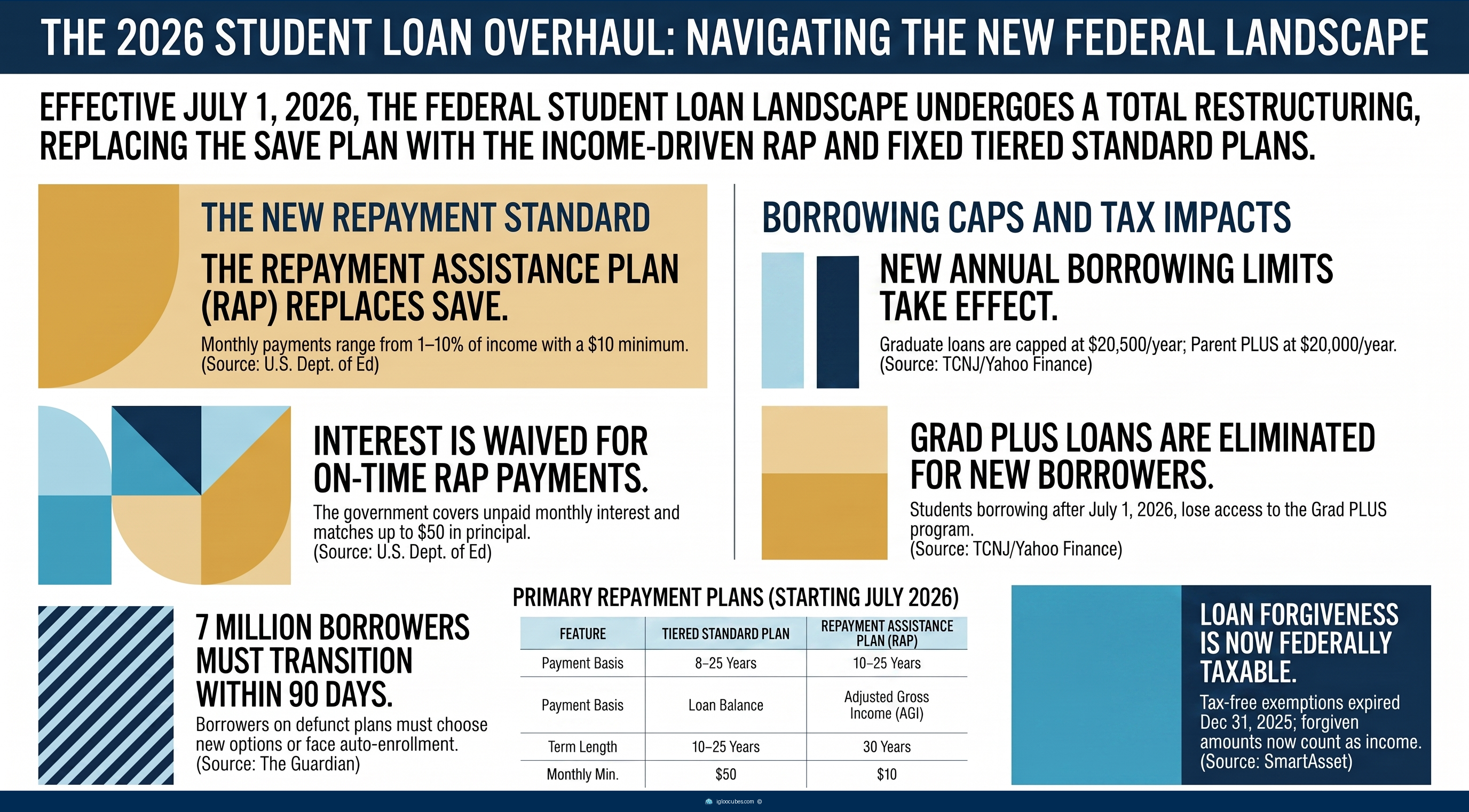
A massive student loan overhaul is taking shape in 2026, driven by the One Big Beautiful Bill Act (OBBBA, signed July 4, 2025) and several major court rulings. If you have student loans or plan to borrow, the rules of the game have changed — and which rules apply depends on when you borrowed and who you are.
Here’s the breakdown by borrower type, plus the full timeline and what’s still uncertain.
SAVE Plan Enrollees (7.5 Million Borrowers)
What happened: The SAVE plan was ruled unconstitutional and terminated. A federal court vacated the plan on March 10, 2026 (following a March 9 Eighth Circuit ruling), and the Department of Education began notifying all enrolled borrowers on March 27.
The impact:
- Unpaid interest began accruing again on SAVE balances on August 1, 2025.
- The SAVE plan officially ended on July 1, 2026 when the new repayment rules took effect.
- Borrowers have a 90-day transition window after being contacted by their servicer to enroll in a different plan. If you don’t choose one, you’ll be auto-enrolled in an alternative plan — and it won’t be the cheapest option.
The silver lining: Any payments or progress you made under SAVE while it was active are generally expected to count toward long-term forgiveness. You didn’t lose those months.
Existing Borrowers (Loans Before July 1, 2026)
What changed: Legacy repayment plans are being phased out gradually, and the tax exemption on forgiven debt has expired.
The impact:
- You can keep using traditional plans — 10-year Standard, Graduated, and 25-year Extended.
- PAYE and ICR are sunsetting. They’re closed to new enrollments as of July 1, 2026, and will be dismantled entirely by July 1, 2028. You must transition to Income-Based Repayment (IBR) or the new RAP before that date, or your servicer will auto-enroll you.
- IBR is stable for existing borrowers. It remains active but is restricted to loans disbursed before July 2026, making it a highly stable route to forgiveness if you’re already on it.
- Forgiveness is taxable again. The temporary tax exemption expired December 31, 2025. Any income-driven forgiveness received in 2026 or later is federally taxable. PSLF and disability discharges remain tax-free.
New Borrowers (Loans on or After July 1, 2026)
What changed: Repayment options are simplified but safety nets are narrower.
The impact:
- Only two repayment plans: The Tiered Standard plan (fixed payments over 10 to 25 years, $50 minimum) and the Repayment Assistance Plan (RAP).
- RAP is your only income-driven option. Payments capped at 1% to 10% of AGI with a $10 minimum for incomes under $10,000. Includes a $50/month deduction per dependent, waives all unpaid monthly interest so your balance never grows, matches up to $50/month in principal payments, and forgives any remaining balance after 30 years.
- Auto-pay bonus: A 1% interest rate reduction for enrolling in automatic payments.
- Fewer safety nets: For loans issued on or after July 1, 2027, economic hardship and unemployment deferments are eliminated entirely. Forbearance capped at nine months within any two-year period.
Graduate and Professional Students
What changed: Tighter federal limits and the end of a major borrowing program.
The impact:
- Grad PLUS is eliminated for first-time graduate and professional borrowers as of July 1, 2026.
- Tighter caps on Direct Unsubsidized Loans:
- Graduate students: $20,500/year, $100,000 lifetime limit
- Professional students: $50,000/year, $200,000 lifetime limit
- Transition window: Existing graduate and professional students retain access to the older, higher limits and Grad PLUS for up to three years or until they complete their programs.
Parent Borrowers (Parent PLUS)
What changed: Tighter caps and no access to forgiveness for new loans.
The impact:
- New Parent PLUS loans are not eligible for RAP. Since RAP is the only income-driven plan going forward, new Parent PLUS loans have no path to PSLF.
- New caps: $20,000 per year per student, $65,000 lifetime limit. Existing borrowers can still access the older, higher limits (up to the full cost of attendance) for up to three years or until the student graduates.
- If you already had Parent PLUS loans: You needed to consolidate them and enroll in an active IDR plan before July 1, 2026 to preserve your PSLF eligibility.
Career and Vocational Students
What changed: Federal financial aid expanded to cover short-term career training.
The impact: The launch of Workforce Pell on July 1, 2026 expands Pell Grant access to high-skill, high-wage, or in-demand job training programs as short as 8 weeks. Students enrolling in approved vocational programs can prepare for careers with little to no student debt.
Borrowers Facing Default
What changed: Collection enforcement is temporarily paused, but default status is not erased.
The impact: The Department of Education paused involuntary collections (wage garnishment, tax refund seizures, Social Security offsets) on defaulted federal loans starting January 16, 2026. This pause remains active during the transition to the new repayment infrastructure.
However, default status is not cleared by the pause. You still need to resolve your default to:
- Regain federal aid eligibility
- Qualify for mortgage approval (CAIVRS)
- Participate in forgiveness programs
Loan Forgiveness: What Still Works
Mass across-the-board cancellation is dead, but targeted programs are still active:
Public Service Loan Forgiveness (PSLF): Work full-time for a government agency or qualifying nonprofit. After 10 years of on-time payments, remaining balance is wiped out tax-free. PSLF, death, and disability discharges remain permanently tax-free under OBBBA.
Long-Term Forgiveness: Pay on an income-based plan for 20 to 25 years and the remainder is forgiven. But the tax-free exemption expired December 31, 2025 — forgiven debt in 2026 or later is federally taxable. The IRS treats canceled debt as income. Plan for that tax bill.
Consolidation vs. Refinancing
Consolidation (federal): Combines your loans at a weighted-average interest rate. You keep all federal protections — income-based payments, forgiveness, deferment. Existing Parent PLUS borrowers could consolidate before the July 1 deadline to preserve a PSLF path.
Refinancing (private): A bank pays off your loans and gives you a new private loan. You might get a lower rate, but you permanently lose every federal safety net. No income-based plans. No forgiveness. No deferment. You cannot undo it.
What’s Still Uncertain
The student loan landscape is far from settled. Several areas remain legally contested, administratively paused, or genuinely unclear:
Ongoing legal battles: Democratic-led states have sued to block the new administration’s loan caps. A federal judge recently blocked a rule that would have stripped public service workers of their forgiveness. Reports indicate federal officials have considered selling student loan debt to private investors — a highly controversial proposal that has drawn intense scrutiny.
Servicer readiness is a real question mark: Transitioning over 7 million borrowers off SAVE is an enormous operational lift. Advocacy groups report severe backlogs — nearly half of surveyed borrowers faced long wait times contacting servicers. Even before the official transition date, borrowers trying to leave SAVE hit major administrative roadblocks. Experts openly question whether servicers or the Department of Education are actually prepared to handle the incoming wave of 90-day transition notices.
SAVE forgiveness credit mechanics: While payments made under SAVE are generally expected to count toward long-term forgiveness, the exact mechanics of transferring those credits through the new system remain slightly ambiguous.
IBR discharge pause: The Department of Education has temporarily paused the actual processing of final IBR forgiveness discharges while it recalculates payment counts. Borrowers can still enroll and earn credit, but there is no announced resumption date for when final loan write-offs will resume.
Default collections pause timeline: Involuntary collections on defaulted loans were paused in January 2026, with a target of July 2026 for the new repayment infrastructure. But the exact rollout and transition back to active collections remains uncertain.
Tax ambiguities on forgiven debt: With the federal tax exemption expired, borrowers face a potential “tax bomb.” Two important nuances:
- The insolvency exclusion — borrowers whose debts exceed their assets at the time of discharge may be able to exclude the forgiven amount from taxable income under IRS rules. But this provision is described as narrow and often misunderstood.
- Borrower defense taxability — unlike PSLF (permanently tax-free), the taxability of a borrower defense discharge depends on timing and remains uncertain.
If you’re worried about how these pauses or legal battles might affect your timeline, the safest move is to plan for the worst case (taxable forgiveness, eventual collections) and be pleasantly surprised by the best case.
Full Timeline
| Date | Event |
|---|---|
| July 4, 2025 | One Big Beautiful Bill Act (OBBBA) signed — restructures federal student loan system |
| Aug 1, 2025 | Unpaid interest resumes accruing on SAVE balances |
| Dec 31, 2025 | Tax-free forgiveness exemption expires — IDR forgiveness becomes taxable in 2026+ |
| Jan 16, 2026 | Department of Education pauses involuntary collections on defaulted loans |
| March 9, 2026 | Eighth Circuit rules against the SAVE plan |
| March 10, 2026 | Court formally vacates the SAVE plan |
| March 27, 2026 | Department of Education begins notifying 7.5M SAVE borrowers of termination |
| July 1, 2026 | Core transition: new plans go live, Grad PLUS shut down for new borrowers, Parent PLUS caps and RAP restriction, legacy IDR plans close, Workforce Pell begins |
| July 1, 2027 | Deferment and forbearance limits tighten for new loans |
| July 1, 2028 | Legacy PAYE and ICR plans dismantled — remaining borrowers must transition |
The Bottom Line
Which rules apply to you depends entirely on when you borrowed. There isn’t one answer for everyone.
- SAVE borrowers — you have a 90-day window. Pick RAP if you need income protection. Don’t let them auto-enroll you.
- Existing borrowers — IBR is your stable path to forgiveness. Mark July 1, 2028 if you’re on PAYE or ICR.
- New borrowers — RAP’s interest subsidy is the most borrower-friendly feature of the new system. The 1% auto-pay discount is free money.
- Grad students — Grad PLUS is gone for new borrowers. Plan around the lower Direct Unsubsidized caps.
- Parent PLUS borrowers — new loans after July 1, 2026 have no forgiveness path. Consolidate existing loans quickly if you still can.
- Career/vocational students — Workforce Pell is new and worth looking into if you’re training for an in-demand field.
- Borrowers in default — the collection pause is temporary, not permanent. Resolve your default while the window is open.
- Everyone — if you’re pursuing forgiveness, remember it’s taxable again unless it’s PSLF. The insolvency exclusion may help but it’s narrow — talk to a tax professional. And assume the transition will be messy — stay on top of your servicer communications.
If you’re planning to return to school or have existing loans in transition, it’s worth building a personalized checklist with your specific deadlines so you don’t miss any critical windows.