
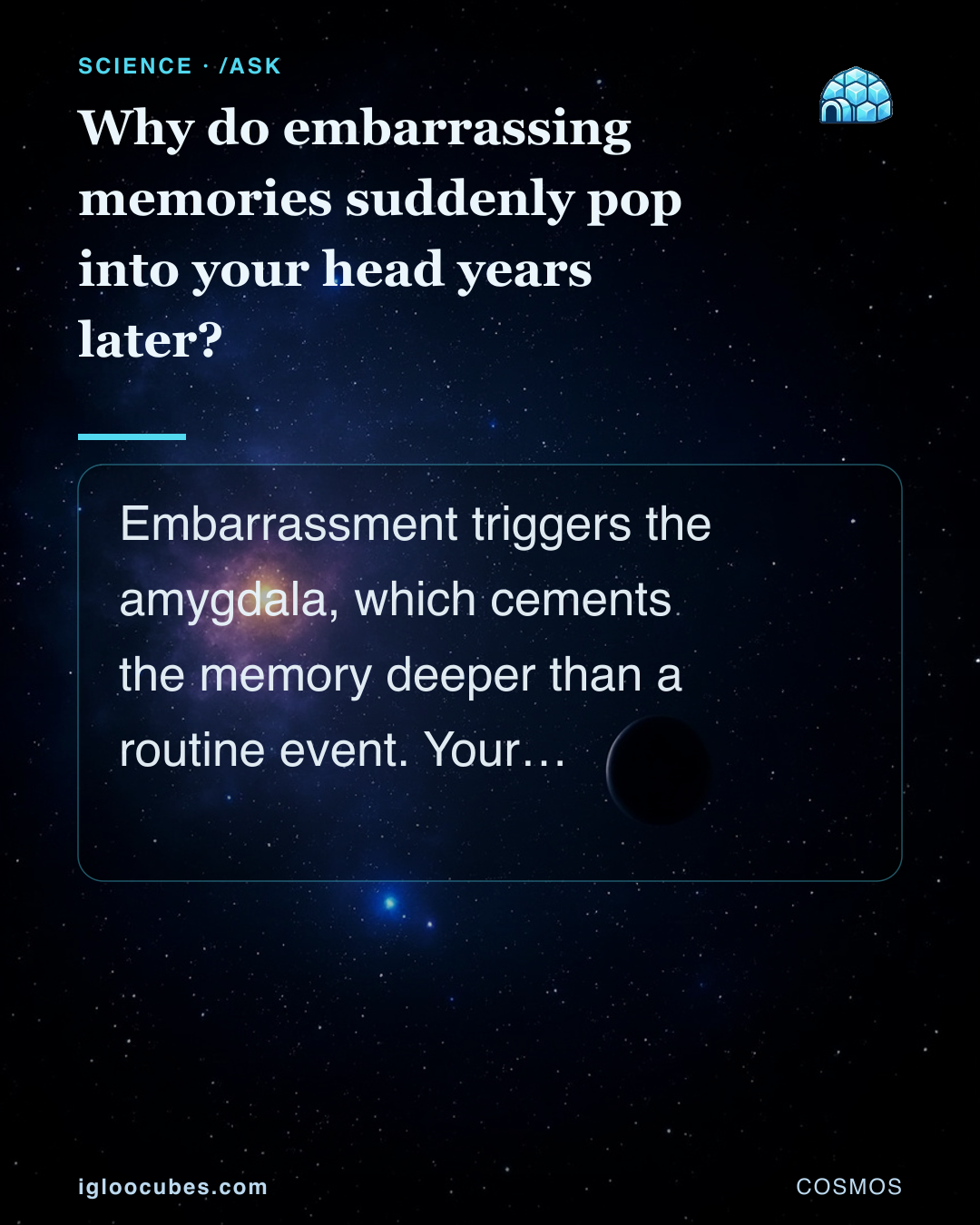
The short explanation is that your brain is wired with a negativity bias—an evolutionary holdover that kept your ancestors alive by making sure they never forgot a dangerous or socially costly mistake. When something embarrassing happens, your amygdala (the brain’s emotional alarm system) fires hard and tags the moment as important. That tag signals the hippocampus to consolidate the memory with extra strength, like hitting “save” twice.
Routine, neutral moments—what you ate for lunch last Tuesday—don’t get that amygdala boost, so they fade. But the time you tripped in front of a crowd? Your brain treated it as a threat to your social standing and filed it accordingly. The memory resurfaces years later because it was encoded so forcefully that even a weak trigger—a similar hallway, a song from that era, or just your brain idling at 2 a.m.—can retrieve it.
This is normal, not a sign that something is wrong with you. The same mechanism is why you can still remember a childhood humiliation in vivid detail but forget a perfectly pleasant meal from last month. Knowing that it’s a feature of your memory system, not a personal failing, can make those sudden flashbacks feel less jarring when they arrive.
Sources
More in Science
Are alien abduction experiences real or explainable by psychology and sleep?
Most alien abduction stories fit sleep paralysis, vivid dreaming, suggestion, and memory effects better than literal extraterrestrial contact.
🔬 Science 5 weeks ago 3 min readCould a large undiscovered primate like Bigfoot still exist in North America?
It’s extraordinarily unlikely. A breeding population would leave bones, DNA, roadkill, or fossils, and North America has no credible evidence of that.
🔬 Science 5 weeks ago 2 min readDoes a true self actually exist?
Psychology treats the true self more like a useful belief or story than a measurable inner object.
🔬 Science 2 weeks ago 2 min read