
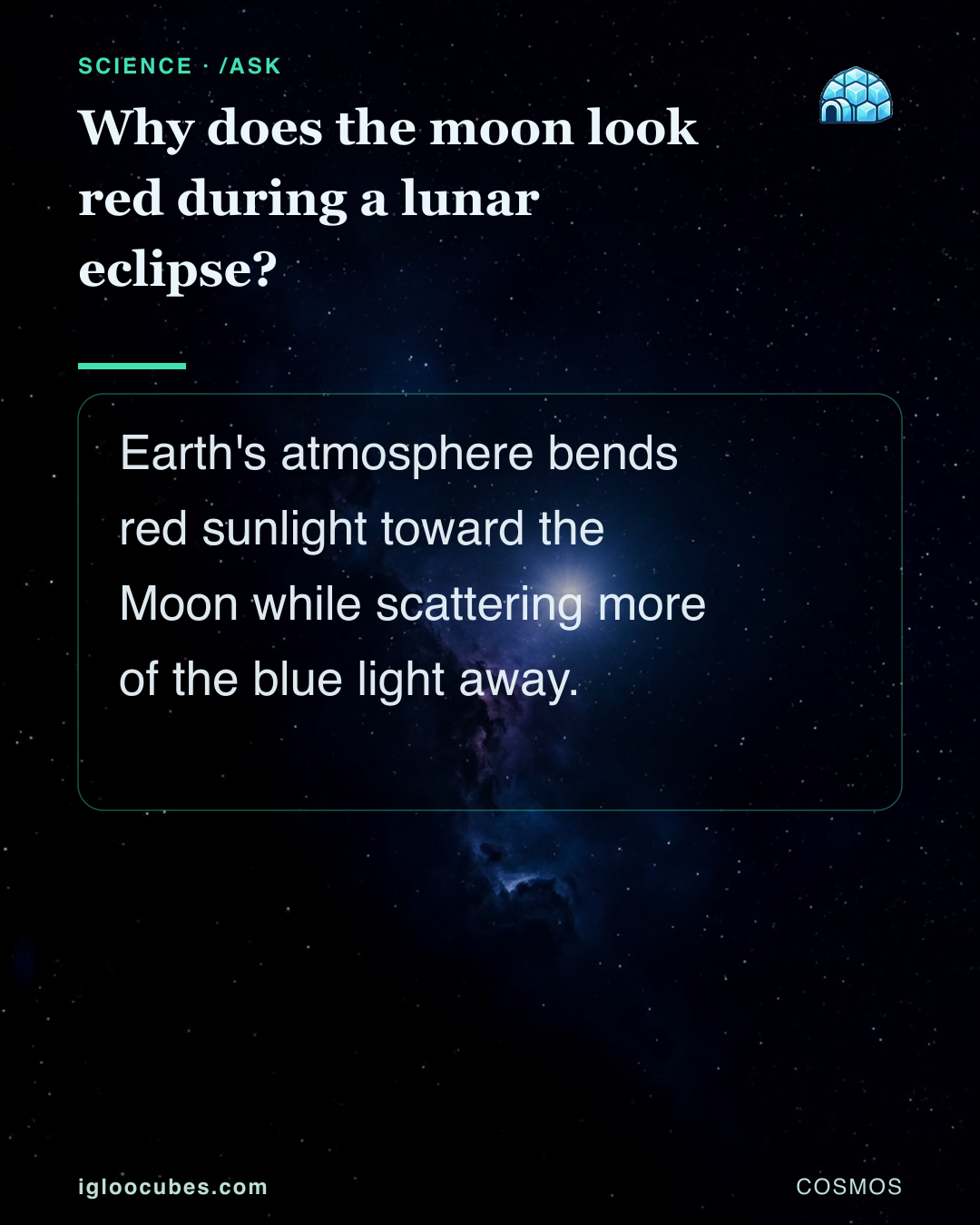
During a total lunar eclipse, Earth blocks most direct sunlight from reaching the Moon. The light that still reaches it has to pass through Earth’s atmosphere first, and that atmosphere scatters shorter blue wavelengths more strongly than red ones.
That is why the Moon can look red, orange, or coppery instead of dark black. NASA compares the effect to all the world’s sunrises and sunsets being projected onto the lunar surface at once. The exact shade depends on dust, clouds, smoke, volcanic particles, and how much atmosphere the light passes through.
The same Rayleigh scattering that makes daytime skies blue and sunsets red is doing the work. Blue light is scattered out of the direct path more easily, while longer red wavelengths bend through the atmosphere and keep going toward the Moon. During totality, the Moon sits inside Earth’s shadow, but that red-filtered light still reaches it.
The Moon does not always look the same color. A clear atmosphere can produce a bright copper eclipse. A dusty or smoky atmosphere can make the eclipse darker. After major volcanic eruptions, lunar eclipses have sometimes looked unusually dim because more sunlight was blocked before it could bend toward the Moon.
So if the Moon looks spooky during an eclipse, nothing strange is happening to the Moon itself. You are seeing sunlight filtered through Earth’s air on its way to the far side of the sky. For a related everyday sky question, see why we sometimes see the Moon during the day. The broader eclipse mechanics are in NASA’s eclipse material cited above.
Related questions
Why do eclipses happen?
An eclipse happens when the Sun, Earth, and Moon line up closely enough that one body casts its shadow on another.
🔬 Science 1 week ago 3 min readWhy do we see the Moon during the day?
Because the Moon is often above the horizon in daylight. It reflects sunlight, so when its position and phase line up, you can see it against a bright sky.
🔬 Science 4 weeks ago 2 min readMore in Science
Are alien abduction experiences real or explainable by psychology and sleep?
Most alien abduction stories fit sleep paralysis, vivid dreaming, suggestion, and memory effects better than literal extraterrestrial contact.
🔬 Science 5 weeks ago 3 min readCould a large undiscovered primate like Bigfoot still exist in North America?
It’s extraordinarily unlikely. A breeding population would leave bones, DNA, roadkill, or fossils, and North America has no credible evidence of that.
🔬 Science 5 weeks ago 2 min readDoes a true self actually exist?
Psychology treats the true self more like a useful belief or story than a measurable inner object.
🔬 Science 2 weeks ago 2 min read