
🧊 The Iceberg
health
Gut Health — Prebiotics, Probiotics & What the Evidence Actually Says
Probiotic supplements, fermented foods, microbiome testing kits — gut health is one of the most marketed areas in nutrition. Here's what the science supports, what's still uncertain, and what's probably not worth your money.
Gut health is having a moment. Probiotic supplements line entire aisles at the pharmacy. Fermented drinks like kombucha and pickle-flavored beverages are trending on social media. Microbiome testing kits promise to decode your inner ecosystem and tell you exactly what to eat.
The science behind all of this is real — but it’s also far less settled than the marketing suggests. Here’s what researchers actually know about the gut microbiome, what they’re still debating, and what shoppers should keep in mind.
The basics: prebiotics, probiotics, and postbiotics
The International Scientific Association for Probiotics and Prebiotics (ISAPP) defines these terms carefully, and the distinctions matter:
Prebiotics are substrates that are selectively used by host microorganisms to confer a health benefit. In plain English: they’re types of fiber that feed the good bacteria already living in your gut. Think oats, bananas, garlic, onions, and asparagus. The evidence for prebiotic fiber is the strongest of the three categories — it’s well-established that a diverse fiber intake supports a healthy microbiome.
Probiotics are live microorganisms that, when administered in adequate amounts, confer a health benefit on the host. The “adequate amounts” and “health benefit” parts are doing important work here. Not all live microbes in food qualify. To be called a probiotic, a product must contain identified strains with documented health effects in specific conditions. Fermented foods contain live microbes, but most haven’t been tested to this standard.
Postbiotics are preparations of inanimate microorganisms and/or their components that confer a health benefit. This is the newest category — a preparation of dead bacteria or bacterial byproducts that still produce measurable effects. The ISAPP consensus definition was only formalized recently, and the evidence base is still thin.
How diet affects the gut microbiome
Fiber diversity is the single most reliable intervention. The more types of plant fiber you eat, the more diverse your gut bacteria become. Higher microbial diversity is consistently associated with better metabolic and immune health. This isn’t a supplement play — it’s a “eat a wide variety of fruits, vegetables, whole grains, and legumes” play.
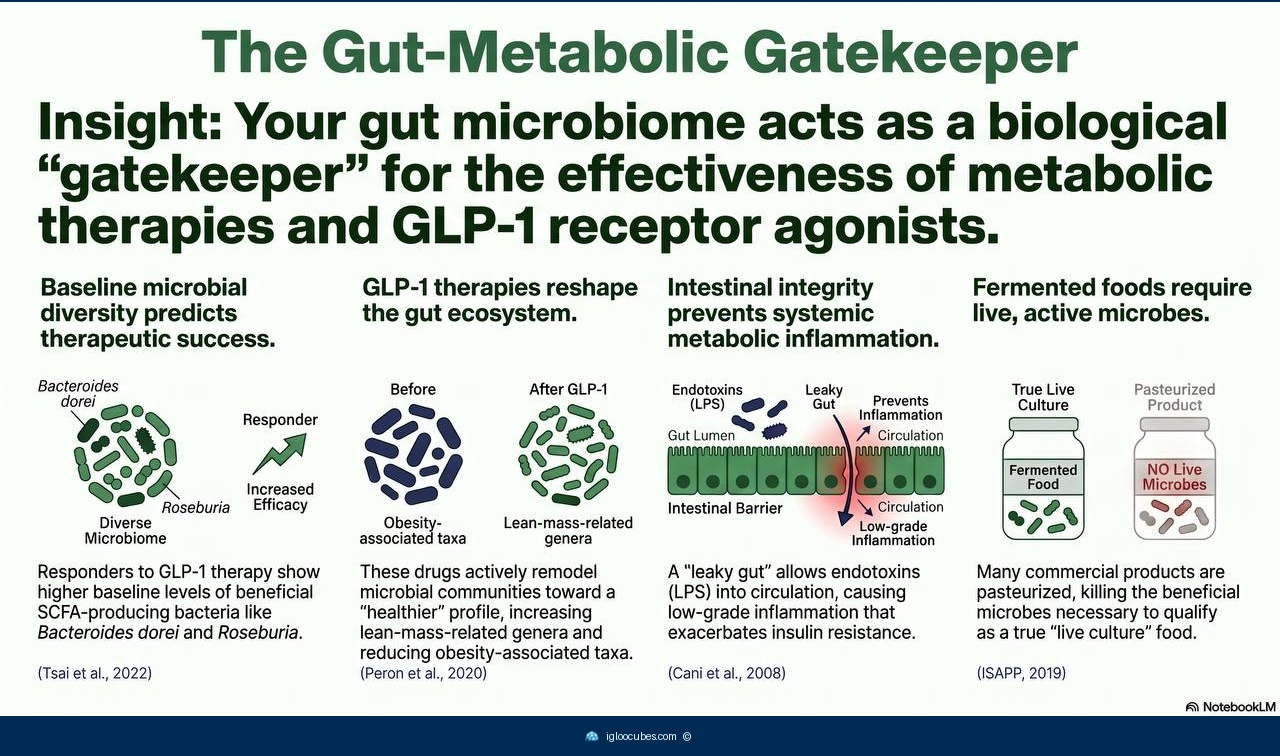
Ultra-processed foods disrupt the microbiome. Emulsifiers, artificial sweeteners, and low fiber content in ultra-processed foods have been linked to reduced microbial diversity and increased intestinal permeability (sometimes called “leaky gut”). Recent studies in Cell and Nature have strengthened this connection, though most research is still in animal models rather than large human trials.
High-sodium diets affect gut bacteria independently of blood pressure. Salt intake appears to shift the gut microbial community in ways that influence inflammation pathways (specifically the TH17 axis), even in people whose blood pressure remains normal. This is a newer finding and the human evidence is still limited by small sample sizes.
Polyphenols matter. Compounds found in berries, dark chocolate, green tea, and olive oil are fermented by gut bacteria into bioactive metabolites that reduce inflammation. The mechanism is better understood than the dosing — we know it works, but we don’t know the optimal amounts.
The evidence for probiotic supplements
This is where the gap between marketing and science is widest.
Some conditions have decent evidence. Probiotics show the strongest support for preventing antibiotic-associated diarrhea, reducing the duration of infectious diarrhea, and managing symptoms of certain bowel conditions like ulcerative colitis. The specific strains matter enormously — Lactobacillus rhamnosus GG and Saccharomyces boulardii are among the best-studied.
Most conditions don’t have enough evidence yet. Despite the proliferation of probiotic products for everything from eczema to mood to immunity, systematic reviews consistently find inconsistent or inconclusive results. Many studies are small, underpowered, or poorly controlled. The NCCIH at NIH characterizes the evidence for most probiotic uses as “promising but not proven.”
Strain specificity is everything. A probiotic that works for one condition (say, preventing antibiotic diarrhea) may do nothing for another. And the effects are often individual — your response depends on your existing microbiome composition, diet, and genetics. This is why two people can take the same probiotic and get completely different results.
Fermented foods: not all are probiotics
This is one of the most common misunderstandings in the gut health space.
ISAPP explicitly states that not all fermented foods qualify as probiotics. To earn the probiotic label, a food needs documented health benefits from specifically identified microbial strains. Traditional fermented foods — sauerkraut, kimchi, sourdough, yogurt, kombucha — contain live microbes, but they consist of undefined microbial communities, and their health effects haven’t been tested to probiotic standards for specific conditions.
That doesn’t mean they’re useless. Fermented foods are associated with better metabolic health in observational studies. But the benefits may come from the food matrix itself (the vitamins, polyphenols, and fiber in the fermented food) rather than the live microbes.
The trend-driven versions are especially questionable. Pickle-flavored drinks and other novelty fermented products may not contain live cultures at all after pasteurization. Even when they do, the CFU counts, strain diversity, and stability during shelf storage are rarely disclosed. If a product doesn’t tell you what strains are in it and at what concentration, it’s a drink with vinegar flavor, not a probiotic.
GLP-1 drugs and the gut microbiome
One of the more interesting emerging connections is between GLP-1 receptor agonists (Ozempic, Wegovy, Mounjaro) and gut health. A 2026 narrative review in Frontiers in Endocrinology found that individual variation in how people respond to GLP-1 drugs may be partially explained by differences in their gut microbiome.
The mechanism is plausible: GLP-1s slow gastric emptying and alter digestion, which changes what nutrients reach the colon and when. That shift in nutrient availability could selectively feed or starve different bacterial populations. The early evidence shows distinct microbial differences between “responders” and “non-responders,” but the research is still exploratory. Current human evidence is limited by small sample sizes, predictive rather than direct metabolic measurements, and the challenge of separating microbiome effects from the massive dietary changes that often accompany GLP-1 use.
Microbiome testing: buyer beware
Direct-to-consumer microbiome testing kits are widely available. They analyze a stool sample and return a personalized report on your gut bacteria, often with dietary recommendations.
The scientific consensus: these tests are not ready for clinical use. The ISAPP and NIH both caution that:
- The normal range of a healthy human microbiome is extremely broad — there’s no standard definition of a “good” microbiome
- Results vary significantly from sample to sample within the same person
- The recommendations are based on correlations, not proven causation
- No longitudinal studies show that following test recommendations improves health outcomes
A 2025 review in Nature Reviews Gastroenterology concluded that microbiome testing has research value but no demonstrated clinical utility for healthy individuals. If your doctor recommends testing for a specific medical condition, that’s different. Buying a kit online to optimize your gut health is, at best, money spent on an unproven service.
The bottom line
The science of gut health is real, exciting, and legitimately important. The human microbiome influences metabolism, immunity, and even brain function. But the field is young, the evidence is uneven, and the marketing has run far ahead of the research.
What’s well-supported: Eating a diverse range of high-fiber plant foods. Including fermented foods as part of an overall healthy diet. Avoiding ultra-processed foods.
What’s partially supported: Probiotic supplements for specific medical conditions (antibiotic-associated diarrhea, certain bowel diseases) with specific, tested strains.
What’s not supported yet: Probiotics for general wellness. Microbiome testing for healthy people. Novelty fermented drinks marketed as probiotics. Most broad “gut health” product claims.