
🧊 The Iceberg
wellness
Meditation and the Brain — What Science Actually Knows
Meditation doesn't just calm your mind—it physically changes your brain structure, quiets your default mode network, and may even slow cellular aging. But the research is messier than most headlines suggest.
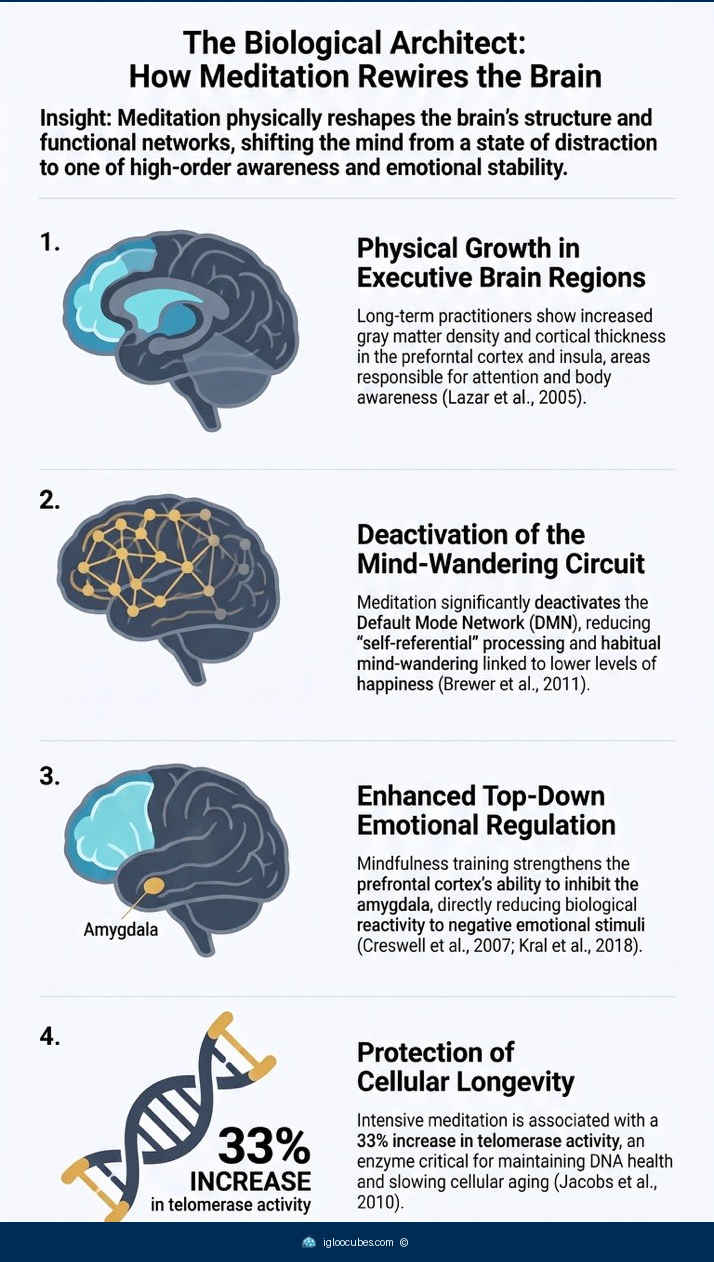
Meditation physically reshapes your brain — not just while you’re sitting quietly, but as lasting changes in structure and function that persist whether you’re meditating or not. Scientists call this the difference between state changes (what happens during meditation) and trait changes (durable shifts that carry into everyday life).
Here’s what the evidence actually says — and where the research is less settled than most wellness articles let on.
What meditation does to your brain
It strengthens the control center and quiets the alarm. Regular meditation thickens gray matter in the prefrontal cortex, the region responsible for attention, planning, and impulse control. At the same time, it calms the amygdala, the trigger point for your fight-or-flight response. The net effect: you get better at noticing an emotional reaction without being hijacked by it.
It quiets the Default Mode Network (DMN). The DMN is the brain system that activates when you’re not focused on anything specific — mind-wandering, self-criticism, replaying yesterday’s argument, worrying about tomorrow. Long-term meditators show significantly less DMN activity, both during rest and during meditation. That’s the neurological basis for the feeling of being “more present”: your brain is literally spending less time on autopilot.
It may protect your cells from aging. A 2010 study from UC Davis found that participants in a three-month intensive meditation retreat had roughly one-third higher levels of telomerase, an enzyme that rebuilds DNA and protects cells from aging. This finding hasn’t been widely replicated, but it’s one of the more intriguing hints that meditation’s psychological benefits may extend to cellular health.
What’s still unsettled
For all the enthusiasm around meditation research, the science is messier than most headlines admit.
Brain wave studies contradict each other. Older research claimed meditation reliably increased alpha and theta waves during practice. But large systematic reviews have found EEG results to be inconsistent, methodologically flawed, and ultimately inconclusive. A 2026 study even found that meditation decreased gamma waves — directly contradicting earlier claims.
Does meditation shrink or grow the amygdala? Some studies find that higher mindfulness correlates with a smaller amygdala; others find a larger one. Both can’t be true simultaneously, which suggests the effect depends on factors researchers haven’t isolated yet — possibly the type of meditation, the duration of practice, or individual differences in how people respond.
The questionnaires might not measure what they claim. Most trait-mindfulness research relies on self-report surveys. A growing number of researchers argue these surveys just capture standard personality traits in disguise. Multiple studies show that experienced meditators don’t necessarily score higher on them than non-meditators, which raises uncomfortable questions about what the field has actually been measuring.
Publication bias is a real concern. Critics note that positive neuroimaging results are more likely to be published than null results, creating a skewed picture of how reliable the evidence really is. When studies that find nothing don’t see the light of day, the published literature exaggerates the strength of the case.
Not all meditation is the same
Different styles produce measurably different brain states. A 2025 study comparing Samatha (fixing attention on a single object, like the breath) and Vipassana (open awareness — noticing whatever arises without clinging to it) found that Samatha creates a highly focused, narrowed brain state while Vipassana nudges the brain toward “brain criticality” — the sweet spot between chaos and order where information processing is most flexible and efficient.
This means the question “does meditation work?” is probably too broad. The more useful question is: what kind of meditation produces which effect, and for whom?
Who benefits — and who doesn’t
Experienced meditators show trait changes even when they’re not actively meditating. Monks with over 15,000 hours of practice have resting brain states that look remarkably similar to their meditative states — the practice has permanently shifted their baseline.
Novices and naturally mindful people benefit differently. They tend to rely more on the prefrontal cortex to regulate their amygdala response when identifying negative emotions. The changes are real but less pronounced than in long-term practitioners.
Older adults may experience slower age-related gray matter loss. Studies of older Zen meditators show a slower decline in regions associated with attention, learning, and cognitive flexibility compared to non-meditators of the same age.
People with anxiety, depression, and chronic pain have the strongest clinical evidence for mindfulness-based interventions. This is where the research is most robust — not just on brain changes, but on measurable symptom reduction.
A small but real subset experiences negative effects. Anxiety, depression, delusions, and fear are documented side effects of intensive meditation, particularly during long retreats. These are heavily underreported in the popular coverage of meditation’s benefits, though researchers have begun calling for more transparency around adverse events.
The bottom line
Meditation does change your brain. The evidence for reduced DMN activity, better emotional regulation, and structural changes in the prefrontal cortex is reasonably solid. And the telomerase finding, while preliminary, is genuinely exciting.
But the hype has outpaced the data in several important areas — brain wave research, questionnaire validity, and publication bias are all legitimate concerns that most wellness content glosses over. A daily meditation practice will probably help you regulate your emotions and feel more present. Expecting it to fundamentally rewire your brain in dramatic ways visible on an EEG is a taller order than most articles admit.