
🧊 The Iceberg
money
Personal Finance Basics — Cash Flow, Savings, Credit, and Simple Investing
Most personal finance advice is about four things: knowing what your money does, keeping enough cash to survive a surprise, building credit without paying for it, and putting the rest somewhere it can grow. Here's the framework that ties them together.
Most personal-finance advice sounds complicated because it’s trying to solve a problem that isn’t the actual problem. The actual problem is almost always one of four: not knowing what your money does, not having a cash buffer, ignoring credit until it’s a problem, or sitting on cash that should be working for you.
Once you name which job you’re behind on, the answer is usually boring. That’s the point.
Job 1 — Track your cash flow
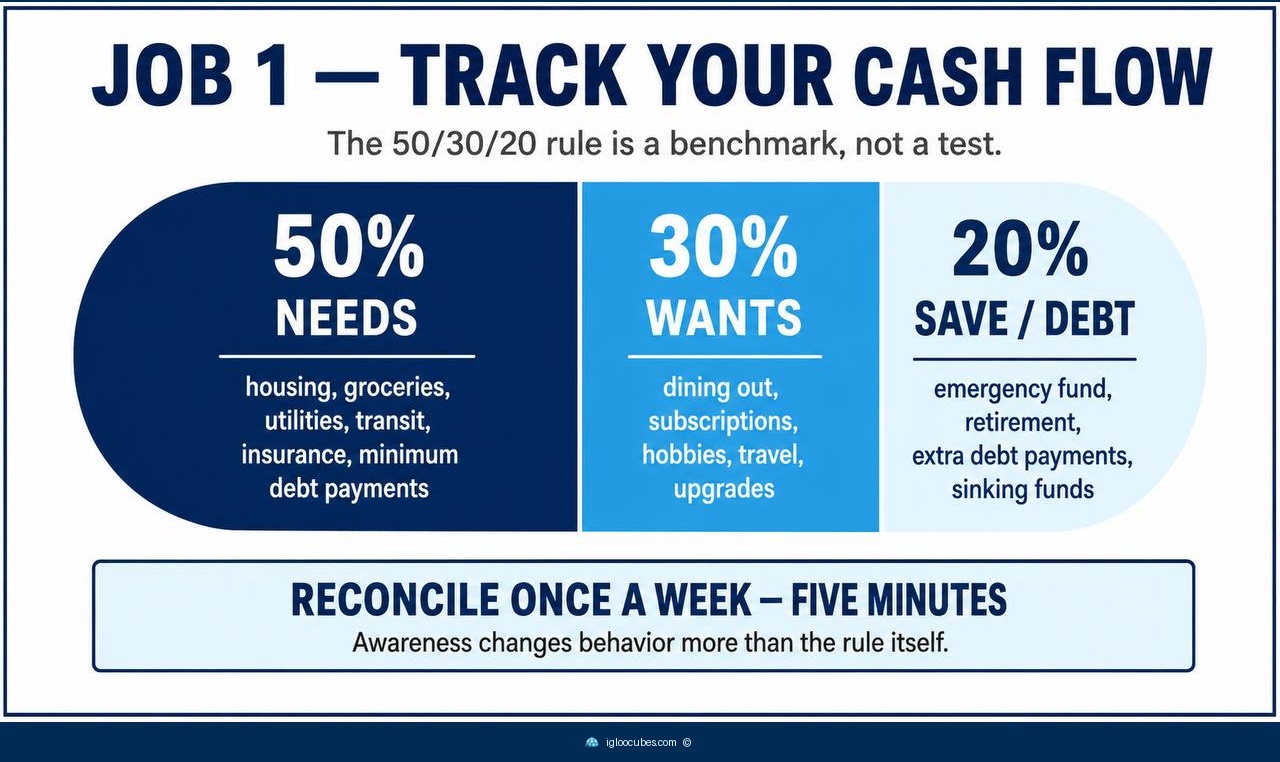
You don’t need a budget. You need a spending plan — a rough map of what your money is supposed to do each month. The 50/30/20 rule (50% needs, 30% wants, 20% savings or debt) is the most-cited starting point. It works for many people, but it’s a benchmark, not a test. In high-rent cities, “needs” alone often blow past 50%, which is fine — the value is in noticing where the money actually goes.
The single most useful habit is reconciliation once a week: open your bank app, look at what you spent, and compare it to what you meant to spend. Five minutes. The research on this is consistent — people who review their spending regularly save more without spending less, because the awareness alone changes behavior.
The trap people fall into: they build a detailed budget, follow it for two weeks, get frustrated when real life breaks the plan, and abandon it. Don’t. A spending plan that you actually check against reality beats a perfect budget you ignore. If a category keeps busting, the answer is to give it more money — not to white-knuckle the spreadsheet.
Job 2 — Hold a cash buffer
A car repair, a medical copay, a sudden flight home — these are not emergencies in the disaster sense. They’re normal life surprises that will happen to you. The question is whether they happen to your checking account or your credit card.
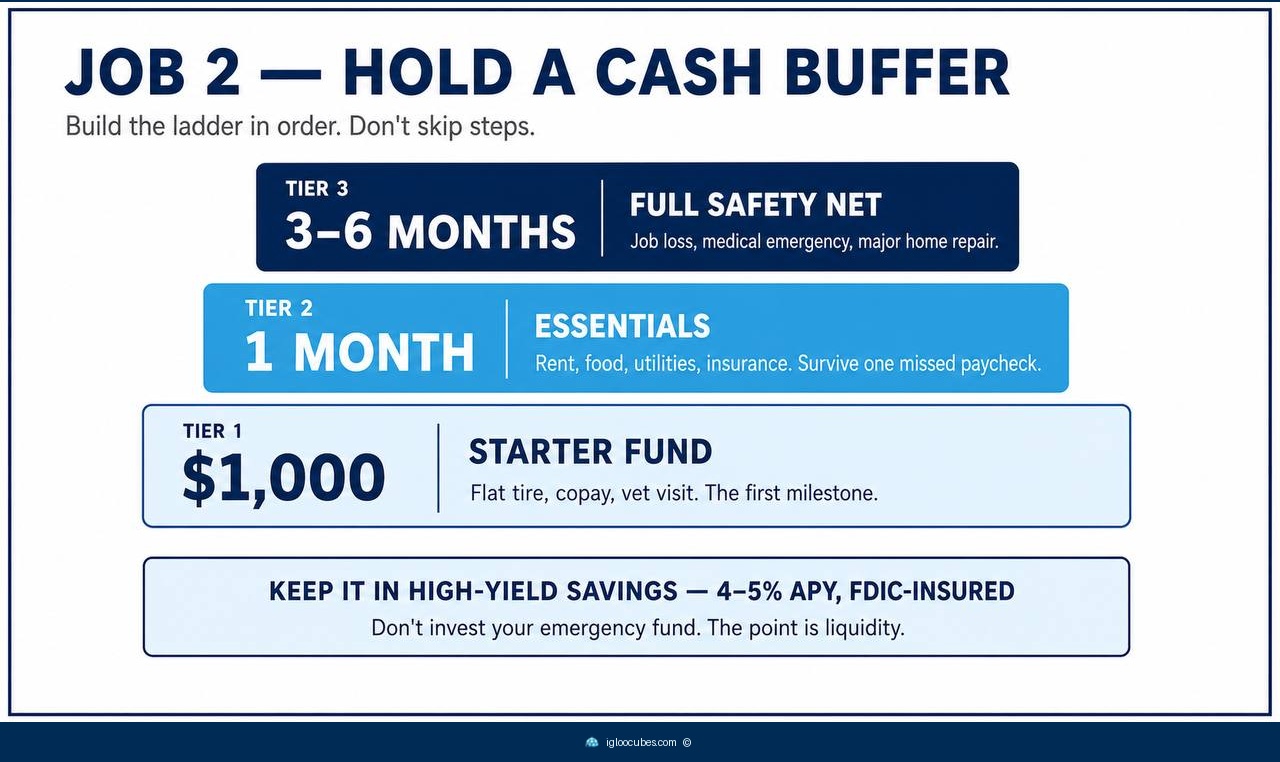
The standard emergency-fund ladder:
- $1,000 starter fund — covers a flat tire, a small medical bill, a vet visit. This is the first milestone and the one most people should hit before doing anything else.
- One month of essentials — rent, food, utilities, insurance, minimum debt payments. This is the “I can survive one missed paycheck” tier.
- Three to six months of expenses — the full safety net recommended for most people. Job-loss territory.
The ladder exists for a reason. Skipping from $0 to six months is hard, demotivating, and usually doesn’t stick. People who try to jump tiers quit before they get there. Build in order. Each tier unlocks the next level of resilience.
Keep the buffer in a high-yield savings account — currently 4-5% APY at most online banks, fully liquid, FDIC-insured. Don’t invest your emergency fund. The whole point is that you can get it in two business days.
For irregular expenses (car insurance, holiday gifts, annual subscriptions), use sinking funds — small dedicated accounts for predictable-but-not-monthly bills. The rule: if you know it’s coming this year, you should already be saving for it.
Job 3 — Build credit on purpose
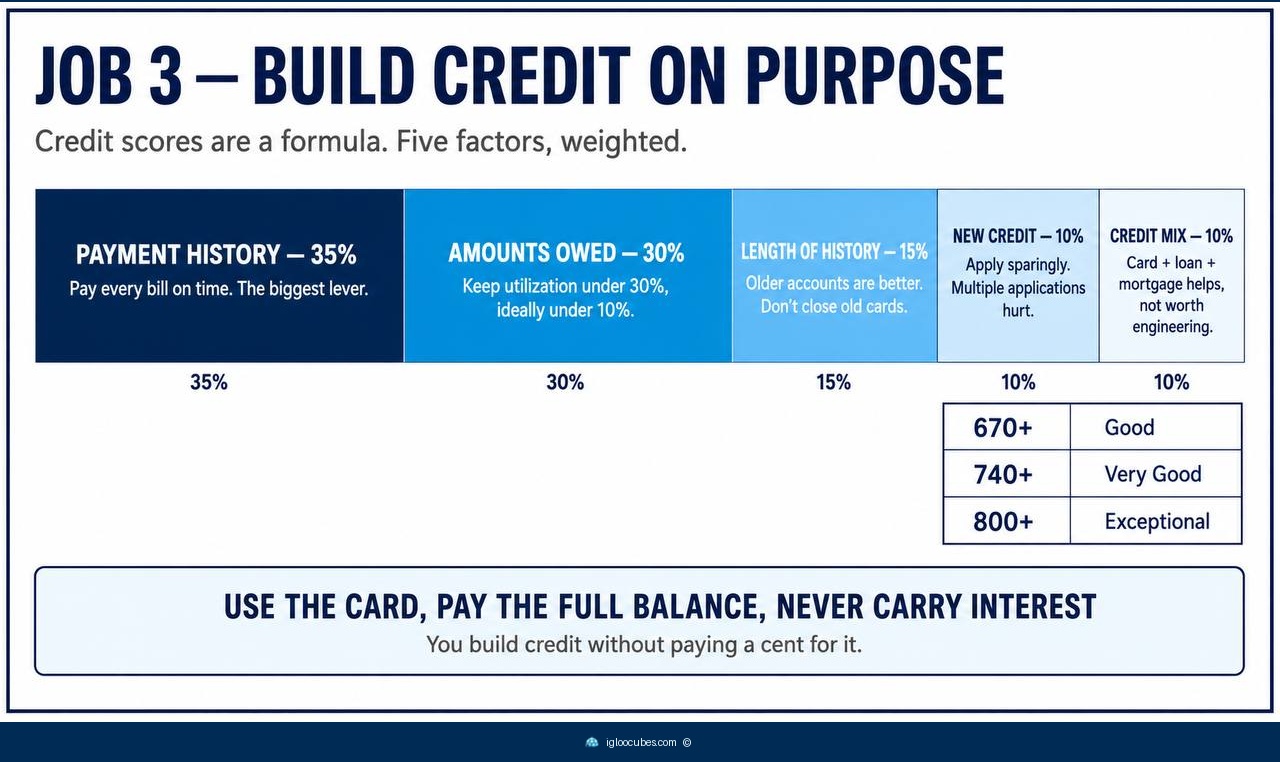
Credit scores aren’t mysterious. FICO publishes the formula:
- Payment history (35%) — have you paid every bill on time? This is the biggest lever.
- Amounts owed (30%) — what’s your utilization ratio (balance ÷ credit limit)? Keep it under 30%, ideally under 10%.
- Length of history (15%) — how old are your accounts? Older is better.
- New credit (10%) — how many accounts have you opened recently? Apply sparingly.
- Credit mix (10%) — do you have different types of credit (card, auto loan, mortgage)? Helpful but not worth engineering.
You build credit by using a credit card for ordinary purchases and paying the full statement balance every month. The card company reports your on-time payments to the bureaus. You pay zero interest because you never carry a balance. Your score climbs because every input is positive.
What kills credit scores:
- Missing a payment (one 30-day late mark can drop a good score by 60-110 points)
- Maxing out a card (utilization above 30% looks desperate, even if you pay it off)
- Closing old cards (shortens your history and reduces your total available credit)
- Applying for several cards in a short window (looks like you’re chasing credit)
What doesn’t help credit scores:
- Debit cards (no credit history is generated)
- Paying interest (paying interest doesn’t help your score — it helps the bank’s revenue)
- Carrying a small balance “to show activity” (this is a myth; it costs you money and helps nothing)
A “good” score is generally 670+, “very good” is 740+, “exceptional” is 800+. The thresholds matter because lenders price based on them — the gap between 720 and 760 on a mortgage can be 0.25-0.5 percentage points, which is real money over 30 years.
Job 4 — Invest the rest
Once you have a spending plan, a cash buffer, and decent credit, the only thing left is putting the surplus to work.
The simple framework:
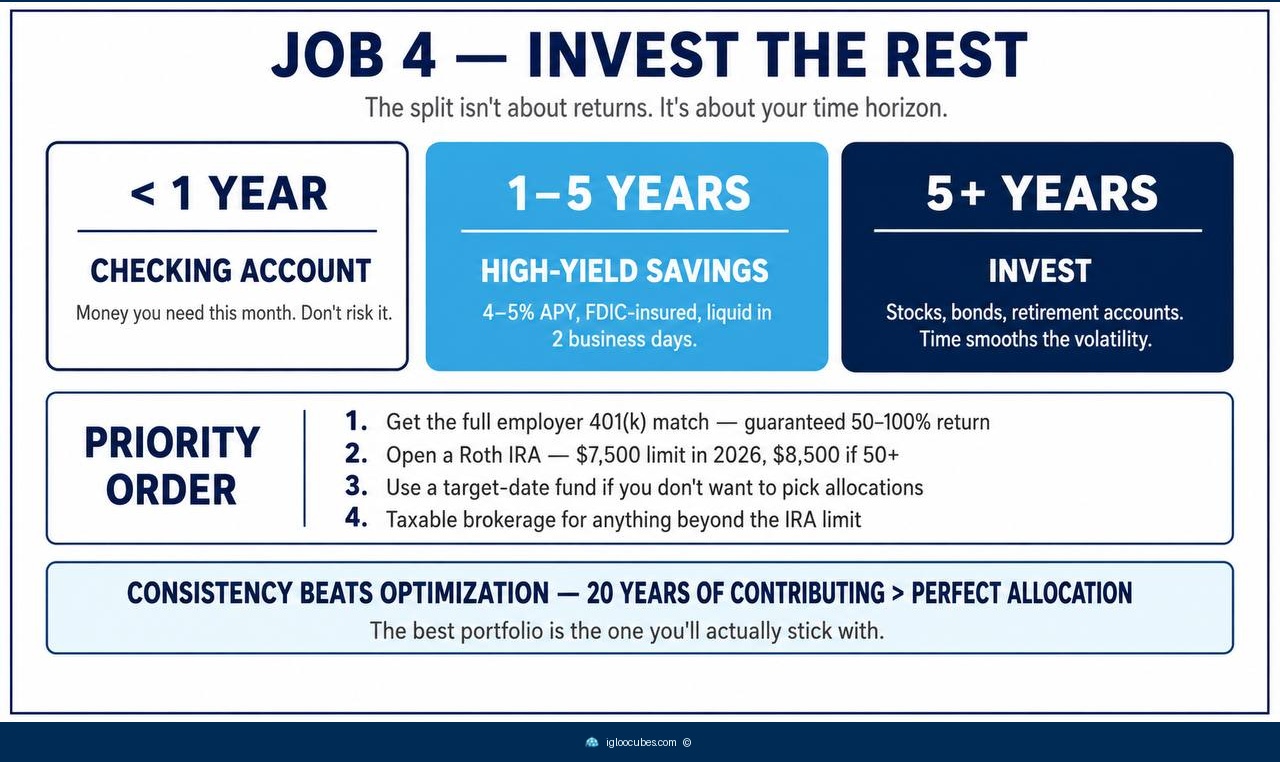
- Money you’ll need in 1-5 years → high-yield savings account (safe, accessible)
- Money you’ll need in 5+ years → invest it (stocks, bonds, retirement accounts)
- Money you’ll need in less than a year → checking account (don’t risk short-term needs)
The split isn’t about expected returns. It’s about your time horizon — markets drop 30% roughly once a decade. If you can ride that out, you’ll likely come out ahead. If you need the money next month, a 30% drop means you can’t pay rent.
Where most people should start:
- Get the full employer 401(k) match if you have one. It’s a guaranteed 50-100% return — nothing else beats it.
- Open a Roth IRA and contribute up to the annual limit ($7,500 in 2026, $8,500 if you’re 50+). The money grows tax-free and comes out tax-free in retirement.
- Use a target-date fund if you don’t want to think about asset allocation. Pick the year closest to when you’ll retire, contribute consistently, and rebalance is automatic.
- If you have leftover money beyond the IRA limit and no employer plan, a taxable brokerage account at a low-cost provider (Fidelity, Schwab, Vanguard) works fine.
Don’t over-optimize. The best portfolio is the one you’ll actually stick with. Picking the perfect asset allocation is worth maybe 0.2% a year in returns. Consistently contributing over 20 years is worth orders of magnitude more.
How the four jobs interact
The jobs aren’t sequential — they’re parallel. Most people work on all four at once, just at different levels of intensity.
A common version of the integrated plan:
- Build the $1,000 starter fund while automating minimum payments on any debt.
- Once starter is hit, throw extra money at the highest-interest debt.
- While paying debt, use a credit card for normal spending and pay it in full each month. Build credit in parallel.
- When high-interest debt is gone, redirect that payment to filling the emergency fund to one month.
- Open a retirement account and contribute enough to get any employer match.
- Once the emergency fund is at one month, redirect future surplus to retirement until you hit 15% of income saved.
- Then build the emergency fund to three months.
- Anything beyond that goes to long-term investing (Roth IRA, taxable brokerage, or 401(k) above the match).
The exact numbers vary. The order doesn’t.
Where this approach has limits
If your income is unstable or below the cost of living in your area, the framework doesn’t quite work because there’s no surplus to direct. In that case, the priorities shift to: stabilize income first, then build any buffer (even $500), then protect credit by avoiding new high-interest debt.
If you have student loans or other low-interest, fixed-rate debt, paying them off early is a choice, not a necessity. The historical spread between investment returns and a 4-6% student loan rate is positive over long horizons — but only if you actually invest the difference and don’t sell in a panic during a market drop.
If you’re optimizing for early retirement or financial independence, the framework still applies but the ratios are different. Saving 50%+ of income requires cuts in the “wants” bucket that the 50/30/20 rule doesn’t accommodate. Treat the rule as a starting point, not a ceiling.
If you have irregular income (freelance, commission, seasonal), the spending plan needs to be built on your lowest reasonable month, not your average. Save the surplus in high-yield months, treat the floor as your real income.
The bottom line
Personal finance isn’t complicated. It’s just four jobs, done in roughly the same order by most people who get ahead:
- Track what your money does
- Buffer the predictable surprises
- Build credit by using it responsibly
- Invest what’s left over a long enough horizon
Most financial stress comes from skipping one of these jobs — usually the cash buffer, sometimes the credit part, sometimes the investing part because it feels optional. None of them are. They’re all load-bearing.
The boring truth is that the people who end up financially secure aren’t doing anything sophisticated. They’re just doing all four jobs, consistently, for a long time.