
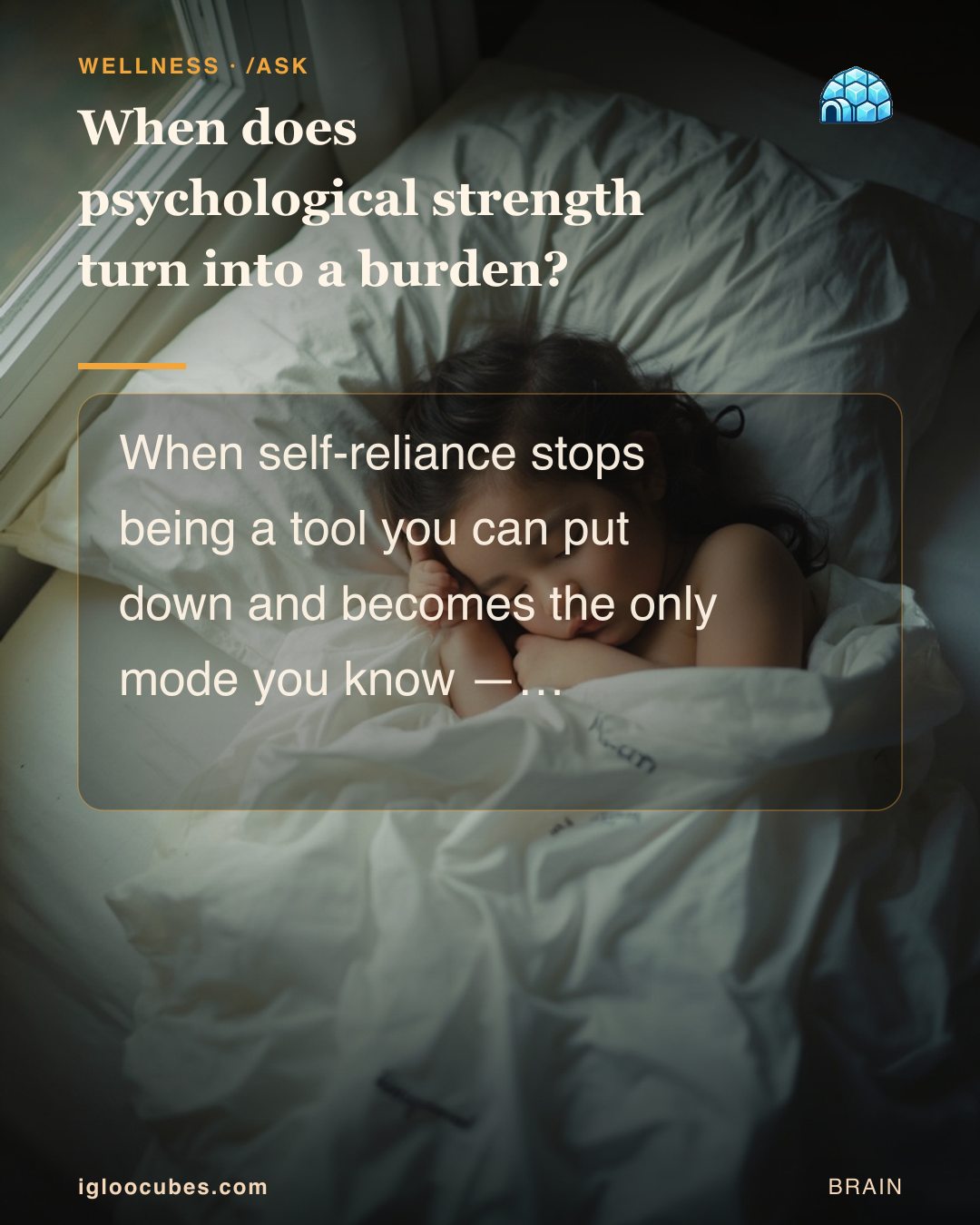
Psychological strength turns into a burden at the moment “I can handle it” stops being a choice and becomes a rule. That is the line where healthy self-trust quietly morphs into hyper-independence — a pattern clinicians describe as extreme self-reliance that shows up as avoiding help, guarding emotions, overcommitting, and treating the acceptance of support as a personal failure. The pattern often looks admirable from the outside while feeling exhausting on the inside.
The costs are well documented and run in two directions. On the relationship side, hyper-independence predicts difficulty with intimacy, chronic low-grade conflict, and burnout from overcommitting — partners and family members describe feeling shut out of someone who seems to be handling everything but is actually struggling alone. On the health side, the CDC’s social-connection work summarizes the broader evidence: loneliness and social isolation raise the risk of serious mental and physical health problems, including heart disease, stroke, dementia, and earlier mortality. Holt-Lunstad’s widely-cited meta-analysis found strong social relationships were associated with a 50% increased likelihood of survival, which makes persistent isolation a clinically meaningful risk factor, not a personality quirk.
The diagnostic question is whether your strength is available or compulsory. Available strength means: I can handle hard things alone when needed, and I can also ask for help when that’s the better move. Compulsory strength means: I should handle hard things alone, full stop, and asking is weakness. The second version often traces back to an environment — family of origin, early career, military training, an abusive relationship — where needing help was punished or unavailable. Strength that was adaptive in that context becomes a liability once the context changes.
Three signals that strength has tipped into burden:
- The list of people you can ask for help is short and shrinking. Not because you don’t have people, but because you’ve stopped letting them in. If you can name fewer than three people you’d actually call in a real crisis, that’s a warning sign regardless of how capable you are.
- You interpret offers of help as transactions. When someone offers to help and your first internal response is to figure out what they want or what you’ll owe them, the strength has become defensive rather than resourceful.
- The body is paying the bill. Insomnia, jaw clenching, gastrointestinal distress, low-grade anxiety that doesn’t go away — these are often the first signs that hyper-independence is running the show, well before any mental health diagnosis appears on paper.
The healthy version isn’t weakness. It is strength that has enough range to include depending on people when depending is the better move. The take-criticism-without-getting-defensive answer covers a related micro-version of the same dynamic — the moment when a strength (in that case, defending yourself) becomes a barrier to useful feedback. And the hard-times-reveal-capacity answer covers the version where the strength you discovered under pressure turns out to need a different shape once the pressure lifts.
The practical move is small and concrete: practice being a recipient before the next crisis forces it. Accept a small offer. Say “I don’t know” once a week. Let someone carry something for you. The capability doesn’t go away — it just becomes a tool you can use when it’s actually the right tool.
Sources
Related questions
Why do hard times reveal your real capacity?
Because adversity surfaces the skills and coping patterns that comfort tends to hide — and researchers have documented both the upside (post-traumatic growth) and the cost (PTSD) of the same exposure.
🧘 Wellness 1 week ago 3 min readHow do I take criticism without getting defensive?
Slow down enough to separate the message from the delivery, treat the first 30 seconds as data rather than verdict, and only respond after you've checked whether any part of it is actually useful.
🧘 Wellness 1 week ago 3 min readMore in Wellness
Are naps good or bad for you?
Short naps (20–30 minutes) reliably boost alertness without hurting nighttime sleep. Long or late naps — past 3 p.m. or over an hour — make it harder to fall asleep at night and leave you groggier.
🧘 Wellness 5 weeks ago 3 min readWhat are the benefits of daily meditation?
The largest meta-analysis to date found moderate evidence that meditation programs reduce anxiety, depression, and pain-related distress — with modest effect sizes and a clear dose-response to daily practice.
🧘 Wellness 8 weeks ago 2 min readCan most people actually handle polyamory?
Some people can, and a meaningful minority already are — but the structure only works with explicit consent, communication, and a willingness to do maintenance work most people underestimate.
🧘 Wellness 1 week ago 3 min read