
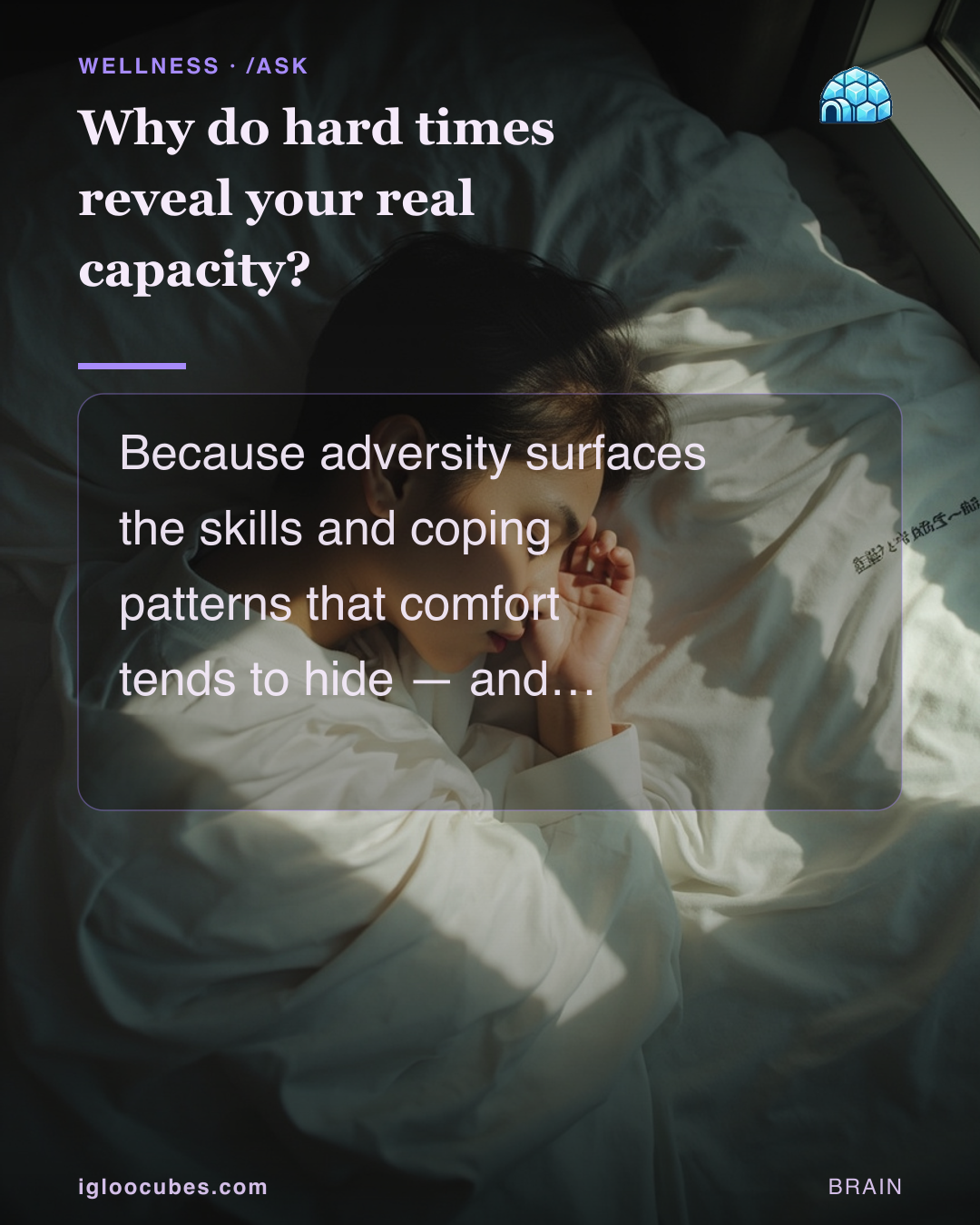
Hard times reveal capacity because they surface the coping patterns that comfort tends to hide. People who never have to dig deep usually never find out how deep they can go — and people who have never faced real loss usually overestimate how well they’d handle it. Stress is, in this sense, a stress test for the parts of yourself that don’t get exercised in everyday life.
Researchers have spent decades on the question of whether adversity builds people up or breaks them down. The honest answer from the data is both, depending on the person and the support available. About 70% of people experience at least one potentially traumatic event in their lifetime, and PTSD develops in roughly 25% of adults exposed to extreme trauma (higher in children). But the same literature that documents that cost also documents an upside: post-traumatic growth, a concept Tedeschi and colleagues developed in the 1990s, describes the phenomenon where survivors report new possibilities, deeper relationships, personal strength, spiritual change, and a richer appreciation of life after going through something difficult. Studies using the Posttraumatic Growth Inventory find that a majority of trauma-exposed people report at least moderate levels of perceived growth, though a long-running methodological debate argues that much of what is measured is illusory growth — feel-good narrative rather than actual behavioral change.
The mechanism behind the revealing effect is partly cognitive: under sustained pressure, you can’t keep running on autopilot. The stories you tell yourself about who you are get tested against what you actually do. People discover resources they didn’t know they had — usually because they had no other choice — and they discover the limits of resources they assumed were infinite (their patience, their physical reserves, their social network). The experience is rarely as clean as “I grew from this.” It’s usually something closer to “I found out what was real, and I lost some things I didn’t think I could lose.”
Three factors predict whether hard times reveal growth or breakdown:
- Pre-existing supports. Holt-Lunstad’s widely-cited meta-analysis found that strong social relationships were associated with a 50% increased likelihood of survival. People with even a small, reliable support network weather adversity better, and that network is rarely built during the crisis — it has to exist before.
- Sense of meaning-making capacity. People who can integrate what happened into a coherent narrative (“this is what I lost, this is what I learned, this is what’s next”) tend to recover faster than people who experience the same event as a permanent rupture.
- Window of recovery. Chronic, unresolved adversity does not produce growth — it produces exhaustion. The hard times that reveal capacity are usually bounded. Ongoing stress without relief does the opposite: it burns people out, the occupational-burnout answer covers that mechanism in the workplace context.
A practical note on the framing: the question assumes hard times are revealing, not creating. They do both. They reveal capacities that were already there, and they create capacities that weren’t. The mistake is reading “I survived this” as automatic proof of growth. Surviving is the floor, not the ceiling. The growth is what you do with the survival — and the psychological-strength-becomes-burden answer covers the version of this where the strength you found turns out to be a trap.
Sources
Related questions
When does psychological strength turn into a burden?
When self-reliance stops being a tool you can put down and becomes the only mode you know — researchers call this hyper-independence, and it has documented health costs.
🧘 Wellness 1 week ago 3 min readHow do I recognize and recover from occupational burnout?
Recognize it by the WHO's three-dimension pattern (exhaustion, cynicism, reduced efficacy). Recover by changing the work pattern itself — not just resting.
🧘 Wellness 1 week ago 3 min readMore in Wellness
Are naps good or bad for you?
Short naps (20–30 minutes) reliably boost alertness without hurting nighttime sleep. Long or late naps — past 3 p.m. or over an hour — make it harder to fall asleep at night and leave you groggier.
🧘 Wellness 5 weeks ago 3 min readWhat are the benefits of daily meditation?
The largest meta-analysis to date found moderate evidence that meditation programs reduce anxiety, depression, and pain-related distress — with modest effect sizes and a clear dose-response to daily practice.
🧘 Wellness 8 weeks ago 2 min readCan most people actually handle polyamory?
Some people can, and a meaningful minority already are — but the structure only works with explicit consent, communication, and a willingness to do maintenance work most people underestimate.
🧘 Wellness 1 week ago 3 min read