
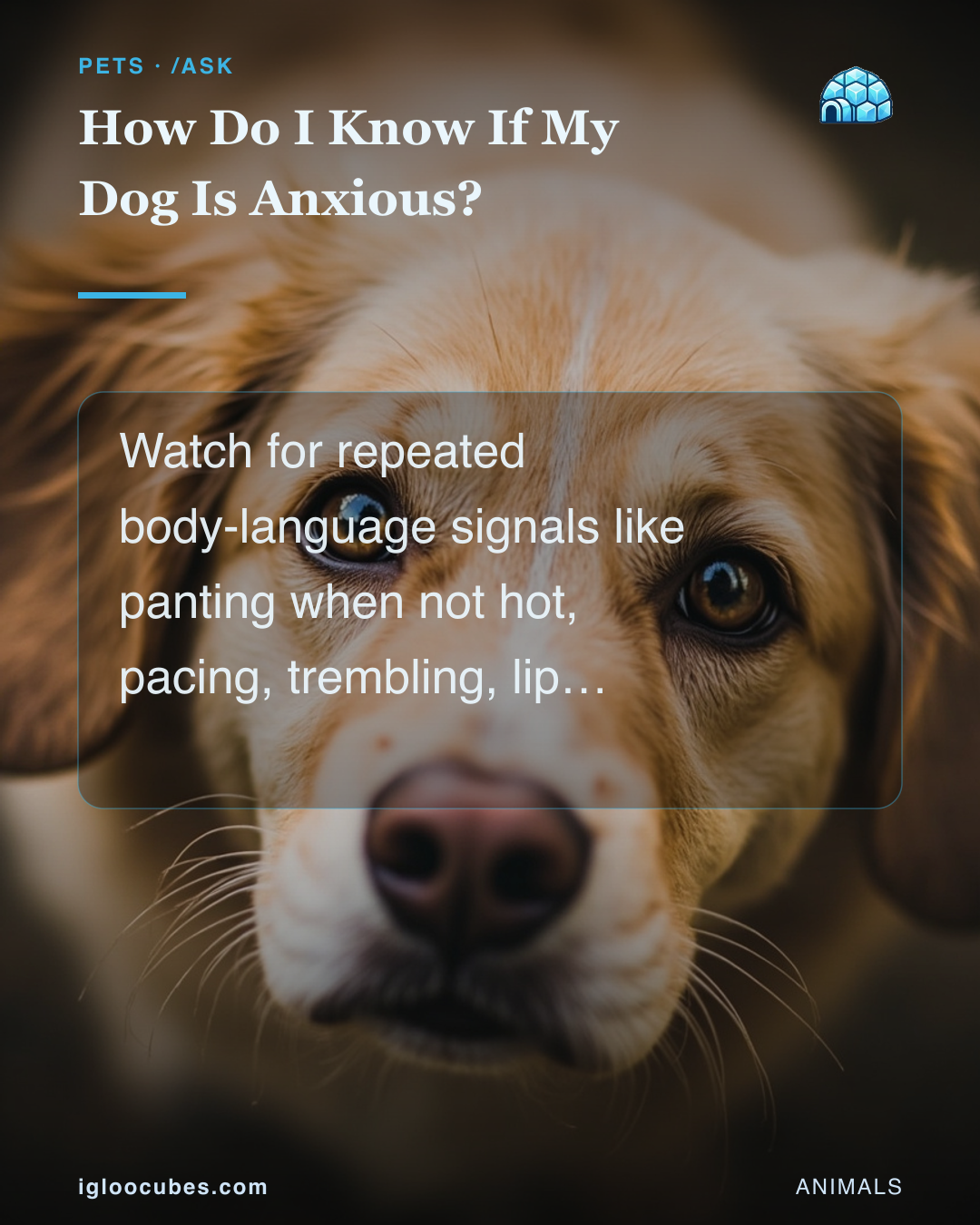
Anxious dogs rarely look like the panting, drooling stereotypes that show up in movies. They usually look “stuck on alert” — tense, watchful, and unable to settle. Cornell’s Riney Canine Health Center describes anxious behavior as a pattern rather than a single moment: the dog is showing several stress signals at once, often in response to a specific trigger like thunderstorms, visitors, car rides, or being left alone.
The body-language signals to watch for include panting when it is not hot, pacing or circling, trembling, drooling, lip licking, yawning when not tired, ears back against the head, whale eye (showing the whites of the eyes), a tucked tail, lowered body posture, sweating from the paw pads, and dilated pupils. Behavioral signs include excessive barking, whining, or howling; trying to hide behind furniture or under tables; escape attempts toward doors or windows; and destructive behavior like chewing doorframes or scratching at exits. Cornell and the ASPCA both note that these signs cluster, and the more signals you see at once, the more confident you can be that the dog is stressed.
The pattern matters as much as the symptom. Dogs who pace and pant only during thunderstorms are usually noise-phobic, while dogs who start whining, drooling, and chewing at the door every time their owner puts on shoes are showing separation anxiety. The AVMA’s review of separation anxiety in dogs notes that true separation anxiety is a distinct condition: it happens consistently when the dog is left alone, often within minutes of the owner’s departure, and is not simply boredom or insufficient exercise. Chewing, urinating, and vocalizing only when alone is a hallmark.
A common mistake is reading pain as anxiety, or vice versa. Cornell points out that an older dog who starts panting, pacing, and being clingy at night may be showing cognitive decline or pain from arthritis, not anxiety. Dogs with abdominal pain often adopt the “prayer position” — front legs flat on the floor, rear end up — which owners sometimes mistake for stretching. If the behavior is new, sudden, severe, or paired with appetite loss, vomiting, or weakness, a vet visit is the right next step before assuming it is emotional.
Once a vet rules out medical causes, management is layered. Mild situational anxiety often responds to a combination of desensitization, counter-conditioning, and predictable routines. Crate training done right gives the dog a safe space, not a punishment space. Pheromone products like Adaptil and compression garments like a ThunderShirt help some dogs, with mixed evidence. For moderate to severe anxiety, especially true separation anxiety, a veterinarian may prescribe fluoxetine, clomipramine, or other medications alongside a behavior plan. AVMA and AAHA both emphasize that medication without training tends to underperform, while training without medication is often too slow for dogs in distress.
The biggest practical win is prevention. Puppies who experience novel people, surfaces, sounds, and handling during their socialization window, roughly 3 to 14 weeks of age, are less likely to grow into anxious adults. For adult dogs who missed that window, slow, positive exposure to new situations is still worth the effort.
If the trigger is loud noise, planning ahead matters. Build a “den” in a quiet interior room with white noise, blackout shades, and a favorite bed or crate, and lead the dog there before the noise starts. Calming treats with L-tryptophan or alpha-casozepine have modest evidence behind them and work best as one piece of a larger plan. For thunderstorms specifically, the AKC advises keeping the dog indoors well before the first clap, because anxiety tends to escalate throughout a storm and prevention is easier than recovery. For related behavior issues, see the dog barking guide and the general pet stress guide.
Sources
Related questions
What are signs my pet is stressed?
Stress signs in pets usually show up as pacing, panting, hiding, vocalizing, or sudden behavior changes.
🐾 Pets 8 weeks ago 2 min readHow do I keep my dog from barking at the door?
Remove the trigger, teach a quiet cue, and reward calm behavior instead of accidentally rewarding the barking.
🐾 Pets 4 weeks ago 2 min readHow do I stop my dog from chewing shoes?
Keep shoes out of reach, give the dog better chew outlets, and add exercise and mental stimulation.
🐾 Pets 4 weeks ago 3 min readWhy do dogs eat grass?
Grass-eating is normal. Most dogs do it because they like the taste or need fiber, not because they're sick. Only about 25% vomit afterward, so it's rarely a sign of stomach trouble.
🐾 Pets 7 weeks ago 2 min readWhy do dogs bark?
Dogs bark to communicate — excitement, alert, boredom, fear, attention-seeking, or as a warning. The reason is usually clear from the tone and situation.
🐾 Pets 7 weeks ago 2 min readMore in Pets
Do I need pet insurance?
Pet insurance makes sense if an unexpected vet bill would strain your budget, especially while your pet is still healthy.
🐾 Pets 5 weeks ago 2 min readDo indoor cats need flea prevention?
Often, yes. Indoor cats can still pick up fleas from dogs, people, other animals, or a contaminated home.
🐾 Pets 4 weeks ago 2 min readHow can I tell if my cat is depressed?
A depressed or stressed cat may hide, eat less, sleep more, groom less, or stop playing, but medical causes can look the same.
🐾 Pets 3 weeks ago 3 min read