
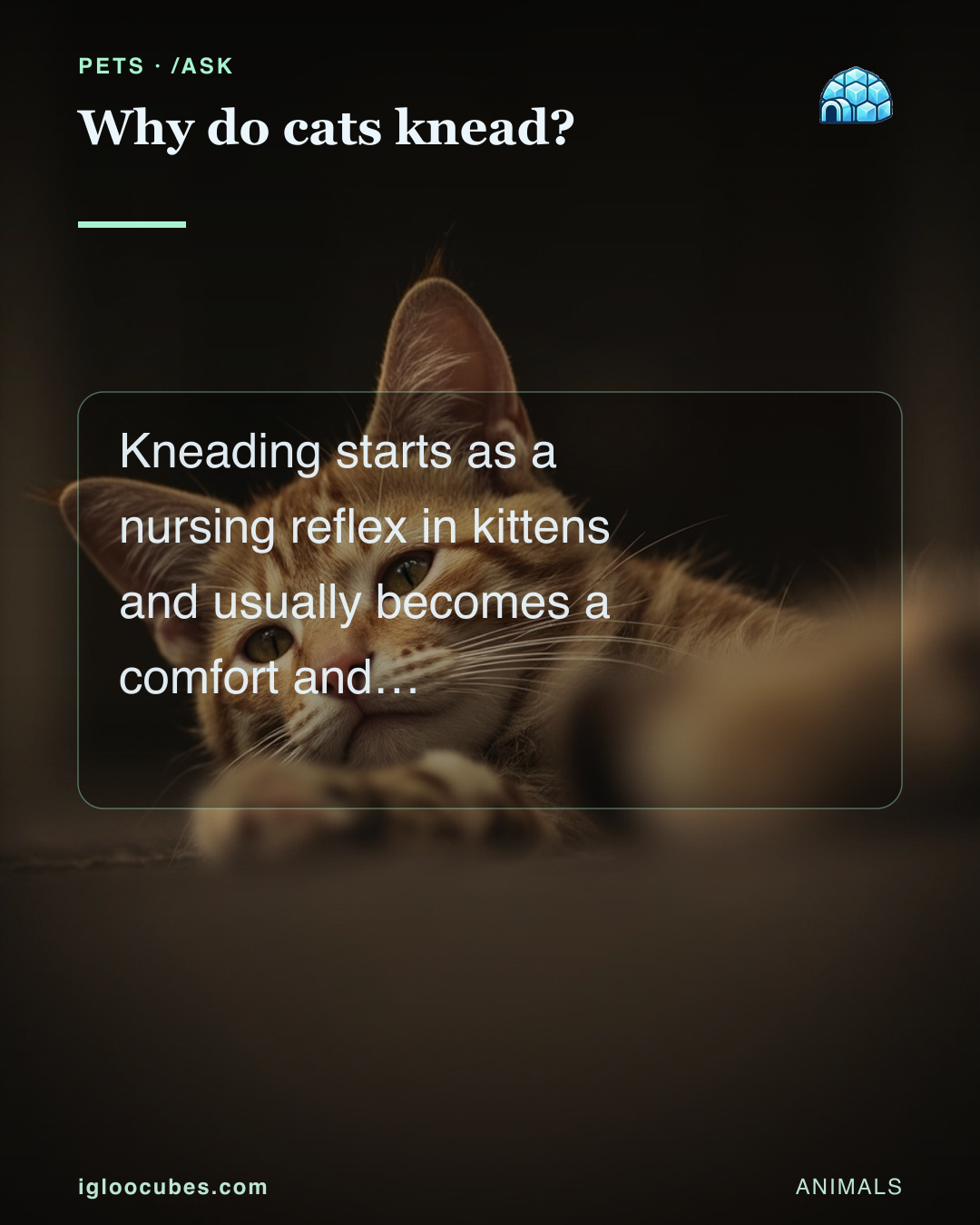
Cats knead by rhythmically pressing their front paws, and sometimes their back paws, against a soft surface like a blanket, a lap, or another cat. Most behaviorists describe it as a leftover nursing reflex. Newborn kittens knead their mother’s belly to stimulate milk flow, and the motion becomes wired into the brain’s reward system because it is paired with food and warmth. Adult cats who knead are essentially revisiting that comforting association, which is why they often purr, drool slightly, or look half-asleep while doing it.
VCA Animal Hospitals explains that kneading in adult cats is usually a sign of contentment and trust. Cats who knead on a person are showing that they feel safe in that spot. The behavior is more common in cats who were weaned a little early, because they had more time to associate the motion with comfort and did not have as long to replace it with adult social behaviors, but it shows up in plenty of well-socialized cats too. There is no harm in letting a cat knead on a soft blanket, but the claws are sharper than the cute nickname “making biscuits” suggests, and many owners keep a thick throw on their lap for that reason.
Kneading is also a way of marking territory. Cats have scent glands in the soft pads of their paws, and the pressing motion deposits pheromones onto the surface. That matters in multi-cat households, where kneading on a shared blanket or bed is a quiet way of saying “this spot is part of my space.” It is also why unneutered male cats may knead more vigorously as part of broader mating-related behaviors; neutering usually reduces the intensity but does not eliminate the comfort version of the behavior.
Some cats also knead to settle a spot before lying down. The instinct is the same one their wild ancestors used to pat down tall grass or leaves into a soft nest. Indoor cats with plush bedding often knead a few rounds before circling and lying down, and the Cornell Feline Health Center notes that this nesting behavior is normal and healthy. It is not a sign of distress, and it usually does not need to be discouraged unless the cat is shredding furniture or injuring skin with claws.
The practical tips are simple. Keep your cat’s claws trimmed with a regular nail clipper or grinder to reduce the scratch factor; a routine trim every 10 to 14 days is enough for most cats. Provide soft, dedicated kneading surfaces like fleece blankets or pet beds so the cat has an obvious target. If your cat suckles on the blanket while kneading, that is the nursing reflex in full force and is usually harmless, though occasional ingestion of fabric can occasionally require a vet visit if it becomes obsessive. The American Association of Feline Practitioners environmental guidelines emphasize that cats need predictable, comfortable resting spots, and a favorite kneading blanket often becomes one of them.
If your cat suddenly starts kneading more than usual or seems unable to settle, a quick vet check is worth it, because pain and anxiety can sometimes present as repetitive comfort-seeking behavior. The behavior is also one of many signs cats use to communicate, and pairing it with other cues — slow blinks, head-butts, and tail-up greetings — usually confirms a relaxed and affectionate cat.
Kittens who are well socialized between 2 and 7 weeks of age tend to knead and purr more confidently around people in adulthood. Cats who were orphaned or hand-reared sometimes knead so vigorously that they actually suckle on the surface, which is the nursing instinct in full force. The Humane Society of the United States notes that occasional suckling is usually harmless, but if it becomes obsessive or your cat is chewing and swallowing fabric, talk to a vet, because pica can lead to intestinal blockages. For more feline quirks, see the cat purring explainer and the cat boxes guide.
Sources
Related questions
why do cats purr
Cats purr both when content and when stressed — the vibrations may help healing and self-soothing.
🐾 Pets 7 weeks ago 2 min readWhy do cats meow?
Cats meow to communicate with people. Different meows mean different things — greetings, requests, or distress — and the meaning depends on pitch, length, and context.
🐾 Pets 7 weeks ago 2 min readWhy do cats like boxes?
Cats like boxes because enclosed spaces reduce stress, help regulate body temperature, satisfy their hunting instincts, and provide a safe retreat when they feel threatened or overstimulated.
🐾 Pets 7 weeks ago 2 min readWhy do cats have whiskers?
Whiskers act as sensory navigation tools, helping cats measure distances, detect vibrations, and navigate in the dark.
🐾 Pets 3 weeks ago 2 min readHow do I keep my cat entertained indoors?
Use short daily play sessions, rotate toys, add scratching and climbing options, and give your cat chances to stalk, pounce, and hunt.
🐾 Pets 4 weeks ago 3 min readMore in Pets
Do I need pet insurance?
Pet insurance makes sense if an unexpected vet bill would strain your budget, especially while your pet is still healthy.
🐾 Pets 5 weeks ago 2 min readDo indoor cats need flea prevention?
Often, yes. Indoor cats can still pick up fleas from dogs, people, other animals, or a contaminated home.
🐾 Pets 4 weeks ago 2 min readHow can I tell if my cat is depressed?
A depressed or stressed cat may hide, eat less, sleep more, groom less, or stop playing, but medical causes can look the same.
🐾 Pets 3 weeks ago 3 min read