
🧊 The Iceberg
health
Food Label Claims — What the Words Actually Mean
The FDA updated its 'healthy' definition for the first time in decades. At the same time, the Upcycled Certified program is growing. Between them, food labels are getting more transparent — but also more confusing for shoppers.
Two major labeling changes are reshaping how Americans think about the food they buy — and neither one is a simple fix.
The FDA updated its definition of “healthy” in December 2024, the first major revision in three decades. And the Upcycled Certified program, which certifies foods made from ingredients that would otherwise go to waste, released version 3.0 of its standard in June 2025. Together, they represent two very different approaches to food transparency: one driven by regulation, the other by a voluntary certification.
Here’s what each means, who it affects, and where the friction is.
The new FDA “healthy” definition — what changed
Before the update, a food could claim to be “healthy” mainly by meeting limits on total fat, saturated fat, cholesterol, and sodium, while providing at least 10% of the Daily Value for certain nutrients like vitamin A, iron, or calcium. That 1994 framework was widely criticized for letting sugary cereals, fruit snacks, and flavored yogurts with high added sugar qualify as “healthy” while excluding nutrient-dense foods like avocados, salmon, and nuts because of their fat content.
Under the new rule, a product must do both of the following to bear the “healthy” claim:
-
Contain a meaningful amount of food from at least one of the core food groups or subgroups recommended by the Dietary Guidelines for Americans — fruits, vegetables, whole grains, dairy, or protein foods.
-
Meet specific limits for added sugars, sodium, and saturated fats.
The compliance timeline:
- Final rule published: December 19, 2024
- Effective date: April 28, 2025
- Mandatory compliance deadline: February 25, 2028
Manufacturers have until early 2028 to update labels and reformulate products if they intend to use the claim.
The FDA is also exploring a standardized front-of-package nutrition label that would make it easier for shoppers to quickly identify healthier options — a move that food manufacturers have resisted for years.
The Upcycled Certified standard — what it means
Separate from government regulation, the Upcycled Certified program certifies food products made with ingredients that would otherwise have gone to waste. The program defines “upcycled foods” as those that use ingredients that would have been discarded but still hold nutritional value, have a verified supply chain, and positively impact the environment.
Version 3.0 of the standard, published June 1, 2025, introduces three certification tiers:
- Upcycled Certified Ingredient — at least 95% of the product’s content by weight is upcycled
- Upcycled Certified Product — at least 10% upcycled content, or a specific tonnage of food diverted
- Upcycled Minimal Content Product — at least 5% upcycled content
Participants must comply with the updated standard by their next annual renewal, but no sooner than 180 days from the publication date. Certification requires auditable supply chain records proving ingredients were diverted from specific waste destinations like landfills or animal feed.
Why it matters: Food waste accounts for roughly 8-10% of global greenhouse gas emissions. If upcycled foods were a country, they’d be the third-largest emitter after the US and China. Programs like this create a market incentive for manufacturers to reduce waste rather than treating it as a disposal cost.
Who’s affected and how
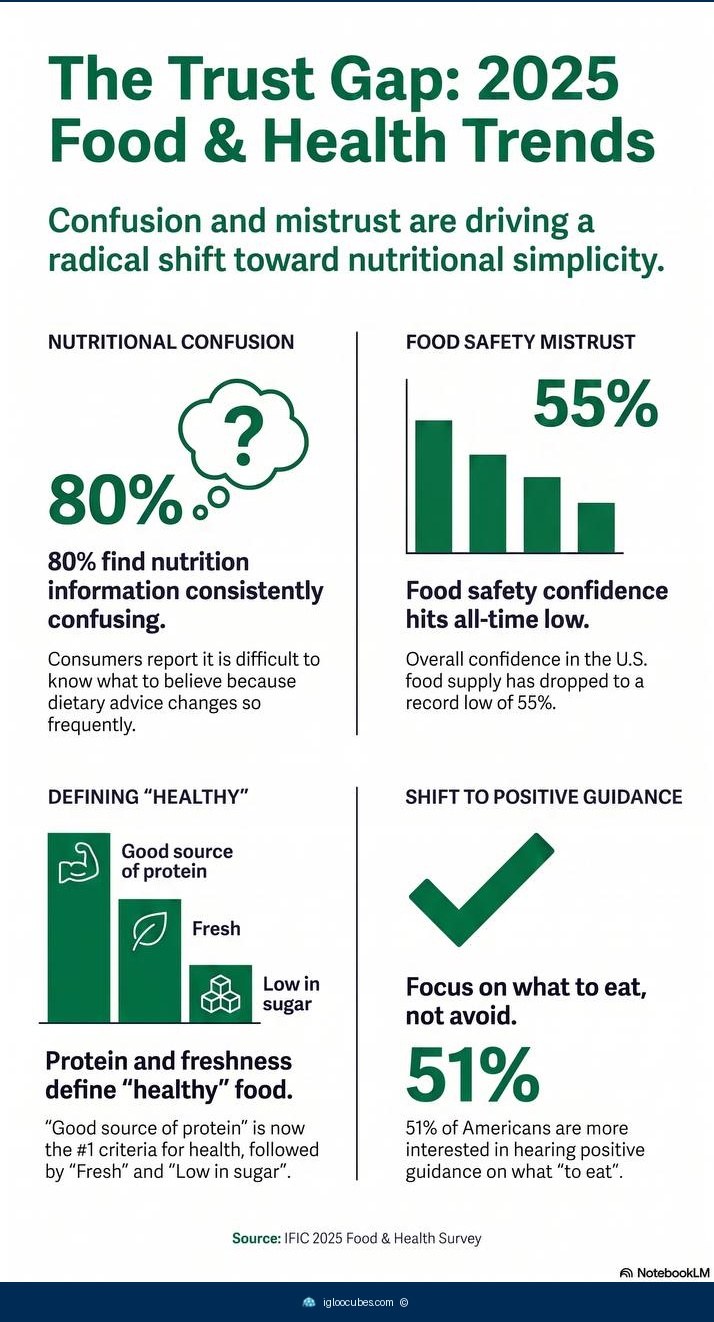
Shoppers get clearer, science-based labels that should make it easier to identify nutritious foods. But there’s a catch: the IFIC 2025 Food & Health Survey found that 80% of Americans find nutrition information confusing because dietary advice keeps changing. And 55% reported an all-time low in confidence about food safety. Adding new labeling — even helpful labeling — comes with a real risk of adding to the noise.
Consumers also define “healthy” in their own ways that don’t always align with the FDA. The top criteria shoppers use: good source of protein, freshness, and low sugar. Freshness and protein content aren’t part of the FDA’s definition at all, which means a food that feels “healthy” to a shopper may not qualify for the label — and vice versa.
Food manufacturers face a clear reformulation incentive. If a brand wants to use the “healthy” claim, it needs to reduce added sugars and sodium while increasing whole-food ingredients. Some will do it; others will skip the label and compete on other claims like protein content or functional benefits (gut health, energy, immunity). The FDA’s own data suggests about 5% of current packaged foods would qualify under the new definition — a significant narrowing.
For the Upcycled certification, manufacturers must maintain rigorous supply chain documentation proving waste diversion. That’s a real operational lift, especially for smaller producers.
Retailers are caught in a liability trap. Without access to manufacturers’ proprietary recipe data, grocery stores can’t independently verify whether a product meets the “healthy” definition. Some retailers want a centralized database of qualifying products to protect against legal risk before they promote or merchandise items as healthy.
Federal assistance programs like WIC may face conflicts. A product that qualifies for WIC benefits (like certain cereals or peanut butters) might not meet the new “healthy” definition, creating confusion for beneficiaries who see mixed signals about what’s recommended.
Where the sources disagree
The “unhealthy” stigma problem. The FDA has explicitly stated that a food not bearing the “healthy” claim is not necessarily unhealthy. But consumer advocates and industry groups both worry this nuance will be lost. If shoppers see “healthy” on some products and assume the absence means “unhealthy,” perfectly nutritious foods that don’t happen to qualify could lose shelf appeal.
Label priority battles. Package space is finite. Some brands would rather use that space to promote functional benefits (probiotics, protein, adaptogens) or lifestyle claims (organic, non-GMO, regeneratively farmed) than the FDA’s “healthy” wordmark. The decision isn’t just about whether a product qualifies — it’s about which message drives more purchases.
Consumer skepticism is rising. The same IFIC survey found that 79% of Americans agree it’s hard to know what to believe because nutrition information keeps changing. Every new label, however well-intentioned, adds another layer. The risk is that well-meaning regulation and certifications, piled on top of each other, make shoppers more cynical rather than more informed.
The upcycled verification challenge. Unlike the FDA’s government-backed definition, Upcycled Certified is a third-party certification. Consumers who are already wary of “clean label” marketing may not distinguish between a legitimate certification with auditable supply chains and a vague marketing term. Building trust for this relatively new category will take time — and consistent enforcement.
What a smart shopper can do
The biggest practical shift from these labeling changes: the word “healthy” on a package is about to mean something more specific than it used to. If you see it after early 2028, you’ll know the product meets defined nutritional criteria. Before then, old packages are still in circulation.
For the upcycled label, it’s worth understanding what the tier system means. “Upcycled Certified Product” (≥10% upcycled content) and “Minimal Content” (≥5%) are different levels of impact. Both are better than nothing, but the tier tells you how much of the product is actually made from diverted ingredients.
And the broader lesson from the trust data: skepticism is healthy, but blanket distrust of all labels just helps the products with nothing to hide blend in. The goal isn’t to trust every claim — it’s to know which certifications have actual standards behind them.